Ingredients
The Ribs
The Rub
The Finish
Instructions
- Cut the rack in half. One long rack is a pain to seal in foil, a pain to fit on a sheet pan, and a pain to handle. Two half-racks solve all three problems. Do it.
- Take the silverskin off. Flip each half-rack bone-side up. See that thin, shiny, papery membrane running the length of the bones? That's silverskin, and it does not break down. Not in 4 hours. Not in 8. Not ever. Leave it on and the underside of your ribs is going to be chewy and rubbery and you're going to blame the recipe. Slip the tip of a paring knife under one edge, grab the loose flap with a paper towel (it's slippery on its own), and peel it off in one long strip. Ten minutes per rack, tops. This is non-negotiable. If any recipe you've ever read said this was optional, that recipe was wrong and I'm sorry you got lied to.
- Mix the rub. Onion powder, garlic powder, brown sugar, smoked paprika, chili powder, cumin, salt, and pepper into a bowl. Give it a stir until it looks uniform.
- Pour in the oil, mix into a paste. This is a wet rub. The oil turns the dry spices into a paste that actually adheres to the meat instead of falling off the second you touch it. If it looks like a thick sludge, you did it right.
- Coat both sides of both half-racks. Rub the paste into every square inch. Top, bottom, the little end nubs. Wear disposable gloves unless you want chili-orange fingertips for the next two days. (Ask me how I know.)
- Marinate overnight. Seal both half-racks in a zip-top bag or airtight container and put them in the fridge overnight. Overnight is the play, not the alternative. The source recipe calls both "room temp for an hour" and "overnight in the fridge" equivalent options. They are not equivalent. Overnight is dramatically better — the salt penetrates, the sugar starts working, the whole thing sits together and figures itself out. "Room temp for an hour" is what you do when you didn't plan ahead. Plan ahead.
- Bring them to room temp. 30-60 minutes on the counter before they go in the oven. Cold ribs straight from the fridge add 30-45 minutes to the cook, and you didn't budget for that.
- Preheat the oven to 250°F. That's not a typo. Low and slow. This is the same principle a smoker uses at 225-250, minus the wood, minus the babysitting.
- Foil the sheet pan and lay the ribs on. Line a large rimmed baking sheet with foil. Lay both half-racks on the foil, bone-side down, long side of each half-rack toward you. Leave enough foil on either side to fold up and over.
- Fold each half-rack into a sealed pouch. Bring the foil up over each half-rack and crimp it into a tight, sealed packet — two independent pouches on the same tray. Tight seals. No gaps. The pouches trap steam, and the steam is what makes the ribs fall-off-the-bone tender.
- Bake at 250°F for 4 hours. DO NOT OPEN THE OVEN. This is the whole recipe. Set a timer. Walk away. Watch a movie. Mow the lawn. Every time you crack that oven door to "check on them," you dump heat and add time. There is nothing to see. The foil is sealed. You cannot check on them without breaking the seal, and if you break the seal you have to re-crimp it and lose more heat. Trust the process. This is not a supervision-required recipe. This is a set-the-timer-and-fuck-off recipe. Set the timer and fuck off.
- After 4 hours, pull the tray out and turn the oven to HIGH BROIL. Let the broiler preheat while you handle the next step.
- Drain the pouches. The pouches will be swimming in rendered fat and juice — that's the sign it worked. Cut a small hole in a bottom corner of each pouch and pour the liquid into the sink. Do not open the pouches from the top first, or you will get molten pork jus down your forearm. Ask me how I know.
- Open the pouches. Peel the foil back and fold it flat so the ribs are exposed on top. Leave the ribs on the tray.
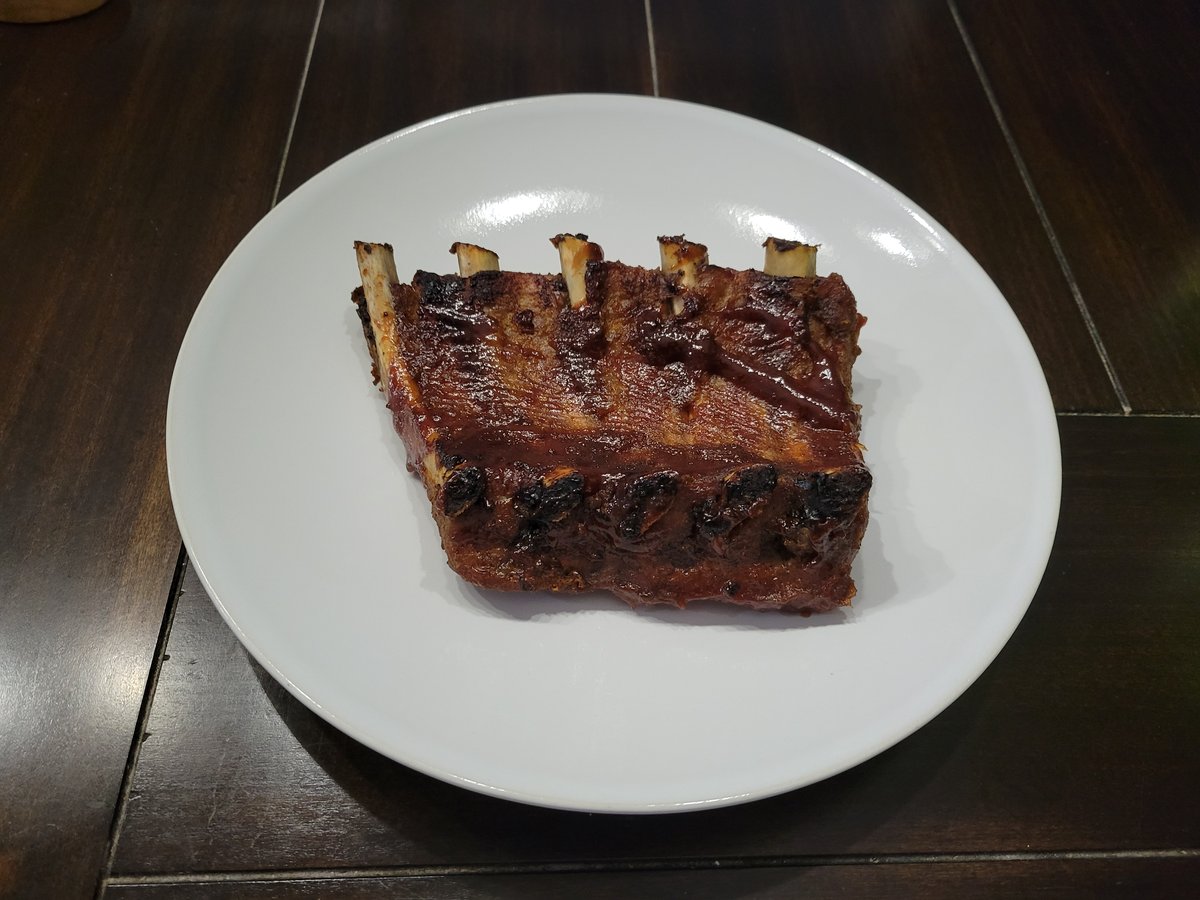
- Finish. Pick a lane. This is where the recipe forks — both endings work, they're just different. See the "Finishing Move" section below for the full breakdown. Short version: broil first (3-5 min), then sauce = glossy soft sauce. Sauce first, then broil (2-3 min) = sticky caramelized glaze. Either way, stay in the kitchen. Broilers go from perfect to burnt to grease fire in the time it takes you to check your phone.
- Cut and serve. Sharp knife between the bones, cut into single ribs or 2-3 bone portions. Serve immediately. Don't let them sit and steam under foil — the whole point of the broil was the texture on top, and you'll wilt it.
The 4-Hour Rule (Do Not Open the Oven)
This is the entire recipe and everyone tries to break it. You put the ribs in the oven, you set a timer for four hours, and you leave. That's it. That's the recipe. Every time you open the oven to peek at your sealed foil pouches — which, remember, are sealed so you can't actually see anything anyway — you dump the oven temperature by 30-40 degrees and the oven has to fight its way back up. Do that three or four times over four hours and you've added 45 minutes to the cook and cooled off the pouches inside. There is nothing for you to see. The foil is opaque. The magic happens in the dark. Set the timer. Go do something else. This is the least supervision-required cooking on the entire site.
Silverskin. Take It Off.
Silverskin is the thin, tough, papery membrane on the bone side of the rack. It's connective tissue that does not render, does not soften, and does not go away no matter how long or how low you cook. Every recipe that tells you it's "optional" is politely misinformed. Leave it on and the underside of your ribs will be rubbery, chewy, and unpleasant to eat — and you will assume something is wrong with the recipe, and the recipe will be fine, and you will be wrong.
How to take it off: flip the rack bone-side up. Find the corner where the membrane is loosest — usually one of the end bones. Slip a paring knife tip under the membrane and lift a flap. Grab that flap with a dry paper towel (the paper towel gives you grip; your fingers will slip). Pull steadily and it usually comes off in one long strip. If it tears, start again from the next corner. Five to ten minutes per rack. That's the entire cost. Do it.
Pick a BBQ Sauce Like an Adult
The source recipe says "your favorite BBQ sauce" and moves on. We're not going to move on. Your choice of BBQ sauce is 30% of the finished flavor of these ribs. Pick with intent.
What to buy: a real bottled American BBQ sauce. Sweet Baby Ray's if you want sweet Kansas City. Stubb's if you want Texas-leaning and thinner. KC Masterpiece if you're feeling nostalgic. Any of these three, and you're fine.
What NOT to buy: the "hand-crafted small-batch cauliflower-ranch smoked-mesquite honey-chipotle apple-cider-fig-reduction" bullshit in the fancy grocery aisle. It's twelve dollars, it's got the sugar dialed to 4, and it tastes like a candle. Not the answer.
Also NOT the answer: skipping the sauce entirely because you "prefer them dry-rubbed." Fine, that's a legitimate opinion for a different recipe. This recipe has a sauce step. If you truly hate BBQ sauce, why are you making babyback ribs.
Pick a lane — Kansas City, Memphis, Carolina mustard, whatever — and commit. Don't apologize for it. Don't mix three sauces. Pick one.
The Finishing Move: Broil Then Sauce, or Sauce Then Broil
The source recipe says: broil for color, THEN brush on sauce. That works, and it gives you a glossy, soft, wet sauce sitting on top of crispy rib. It's the "shiny" ending.
The other option: sauce THEN broil for 2-3 more minutes. The sugars in the sauce caramelize onto the meat, the sauce goes from glossy to sticky, and you get the lacquered, tacky-in-a-good-way finish you'd get off a smoker with a mop sauce. This is the "sticky" ending.
Both are correct. Pick one. If you don't know which you like, do one rack each way and figure it out. What is not correct is standing there indecisively while the broiler does whatever it wants to your ribs. Broilers work fast. Stay in the kitchen. Watch the tray. If you smell smoke, pull it. If the sauce is bubbling and getting dark spots, pull it. This is the only step in this whole four-hour recipe where you actually have to pay attention. Pay attention.
Red, White, and Ribs (One Line About It)
Ribs are the American national dish. Fight me. On the Fourth of July, or any day the weather cooperates, these are the play — and the fact that they came out of your oven and not off a smoker is between you and this website. The neighbors do not need to know.