Ingredients
What is NOT on this list: "garlic butter" from a plastic tub in the freezer aisle. Jarred minced garlic swimming in water. "Lobster seasoning" from the end-cap at the seafood counter — a red powder that is 60% salt, 30% MSG, and 10% whatever got swept off the floor. If you're paying $8 to $15 per tail, don't finish it with ingredients from the clearance rack.
Instructions
- Thaw the tails completely if frozen. Overnight in the fridge is best. If you forgot — and you did — put them in a sealed zip-top bag and submerge in cold water for about 30 minutes. Do not thaw at room temperature. Lobster at room temp for a couple hours is a bacteria party, and the whole point of lobster is the texture, which you're about to ruin before you've even cooked it. Do not microwave to thaw. That thaws unevenly, starts cooking the edges, and the meat ends up with the texture of a kitchen sponge. Thaw it right or don't start.
- Cut down the top of the shell with kitchen shears. Lay the tail on its back — actually, on its belly, shell side up. Snip from the open end down the center of the top of the shell, all the way to just before the tail flipper. Do NOT cut into the meat itself. You are snipping the shell. Not the lobster. The shell is the hinge; the meat stays whole.
- Cut the top joint just before the tail flipper. One more snip, perpendicular, right across the top of the shell at the base of the flipper. Trust me on this one — it releases the little anchor point where the meat is clamped to the base of the tail. Skip this cut and the meat snags on the way out and tears, and now you're fishing shreds out with a fork like you're cleaning a drain. Takes five seconds. Do it.
- Pry the meat loose with a spoon or butter knife. Run the spoon between the meat and the shell along the sides and the bottom, working it loose. Don't yank. Think of it like getting a stuck ring off a finger — patience, a little wiggling, not force. The meat should come free in one clean piece.
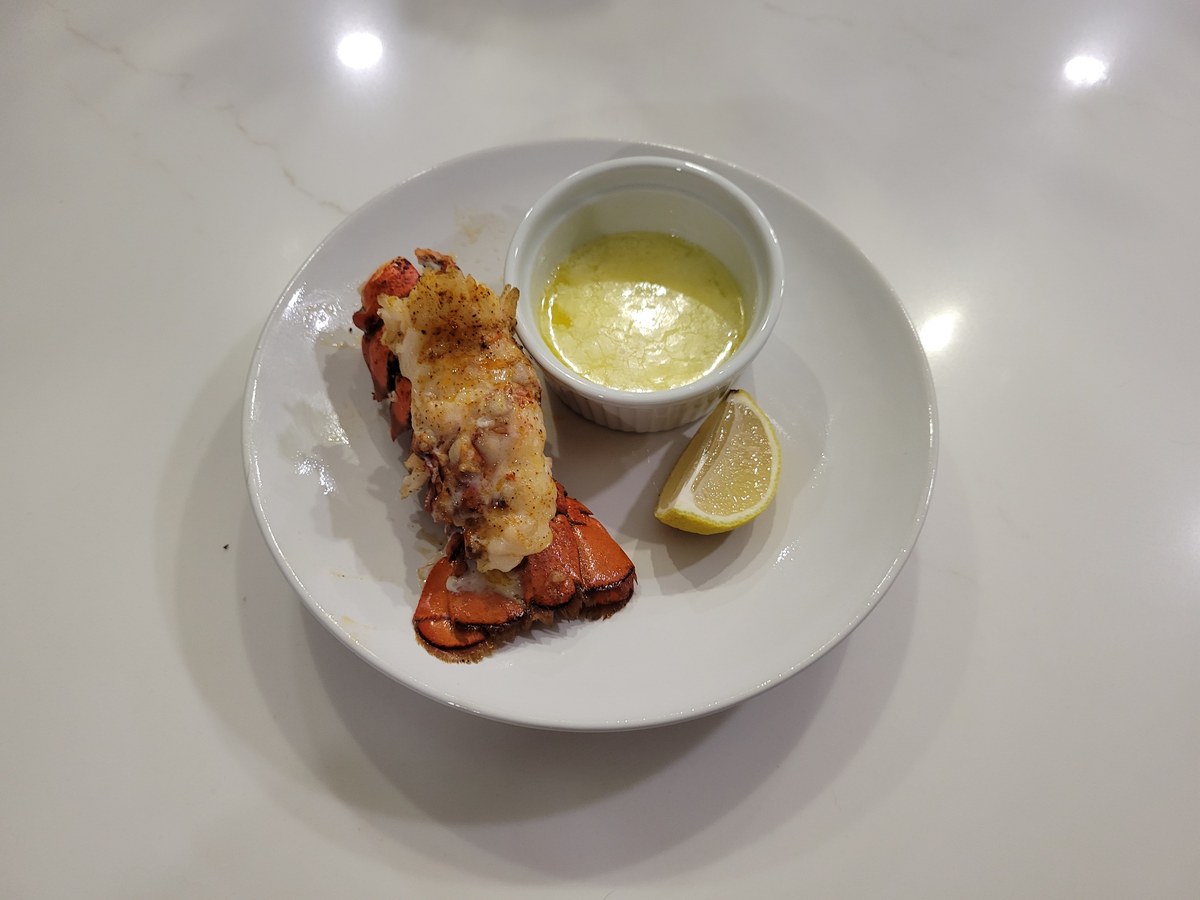
- Pull the meat out and rest it on top of the shell. This is the move. The meat sits on top of its own shell like it's posing for a photo. This is the "butterfly" presentation that steakhouses charge an extra $20 for. You just did it in your kitchen. Charge yourself $20.
- Mix the butter. In a small bowl, stir together the melted butter, minced garlic, salt, paprika, and a squeeze of lemon juice (half the lemon). That's it. Real butter. Real garlic. Real paprika. Takes 90 seconds. There is no shortcut here that doesn't make the result worse.
- Brush the butter mix over the meat. Generously. Get all of it. This is where the flavor lives; don't be shy.
- Place the tails on a parchment-lined baking sheet. Parchment, not foil, not naked pan. Parchment is cleaner, nothing sticks, nothing to scrub.
- Bake at 425°F (220°C). Use the chart below. Rough rule is 1 to 1.5 minutes per ounce. Pull at the LOW end of the range and check for doneness. If it needs 60 more seconds, you put it back in. If you overshot, there is no recovery. Overcooked lobster is rubber. There is no un-rubbering it.
Tail size Bake time at 425°F 4 oz 6-8 min 6 oz 8-10 min 8 oz 10-12 min 10-12 oz 12-15 min - Optional: broil for the last 1-2 minutes to brown the top. Keep an eye on it. Look away for 30 seconds and you've got charcoal. If you're going to broil, do it after you've poured the drink, not before. The drink is the distraction; the broiler is unforgiving.
- Check for doneness. Three signs, all three should be true:
- Meat is opaque white all the way through, not translucent.
- Instant-read thermometer in the thickest part reads 140-145°F (60-63°C).
- Shell turns bright red.
- Serve immediately with extra melted butter for dipping and lemon wedges. If you're not dipping lobster in more butter, I genuinely don't know what you're doing here. Scatter a little parsley on top if you want to earn the Instagram shot.
There Are Only Two Ways To Screw This Up
Overcook it, or butcher the extraction. That's the whole exam. Overcooking is solved by the chart in step 9 and a $12 instant-read thermometer — if you can read numbers and set a timer, you're fine. The extraction is a knife-and-shears sequence (steps 2 through 5) and it takes a little practice, which is what the rest of this recipe is for. Nail both and this is a 25-minute dinner that reads $45-an-entrée on a menu. Flub either and you've just paid steakhouse prices to serve yourself a rubber band in a shell canoe.
Pull It Early. You Can't Un-Rubber Lobster.
Lobster goes from perfect to ruined in about 90 seconds. There is a very narrow window where the meat is tender, snappy, and sweet, and once you shoot past it the proteins seize up and you get the thing people politely call "rubbery" and what it actually is, is a chew toy that cost $12. Start checking at the LOW end of the chart. Pull the pan, probe the thickest part of a tail with an instant-read thermometer, look at the color. If it's under 140°F or still translucent in the middle, put it back for 60 more seconds and check again. You can ALWAYS add time. You can NEVER take it back. Target is 140-145°F in the thickest part. Below 140°F and the center is still gummy. Above 145°F and the texture starts going. This is not a hedge; it's the whole game.
Cut Just Before The Tail — Trust Me On This One
The extra snip across the top of the shell at the base of the tail flipper (step 3) is the single move that separates a clean extraction from a mess. The meat is anchored at that base — there's a little tendon-and-shell grip right there that fights you if you leave it intact. Cutting the top joint releases that anchor, and the meat lifts out in one piece when you spoon it loose. Skip it and the meat snags on the way up, tears halfway through, and you're left pulling shredded pieces out of the shell with a fork like a cave-dweller. Ten seconds with the shears. Saves the whole plate.
Real Butter, Fresh Garlic, Real Paprika
I'm going to say this once. Melted butter, cloves of garlic you minced yourself, paprika (smoked is the upgrade move), a squeeze of lemon. Salt. That's the entire butter mix. Six ingredients. Ninety seconds to assemble. If you reach for the tub of neon-yellow "garlic butter" from the freezer aisle, or the jar of minced garlic drowning in water, or that red dust labeled "lobster seasoning" at the end of the seafood aisle — you are actively making it worse. The whole premise of baked lobster tail is that it's a short list of ingredients cooked precisely. Replacing any of them with the shortcut version is like buying a $90 steak and finishing it with A1. If you're already paying $8-15 per tail, don't pair it with ingredients from the clearance rack.
Broil With A Supervisor
If you broil the last 1-2 minutes for color, stand in front of the oven. Not nearby. In front of it. Lobster goes from gorgeously browned to black carbon in the time it takes to pour a drink. Pour the drink first. Then broil. Watch through the window. Pull it the second the top goes a shade past where you want it, because residual heat is going to carry it another step. The broiler is where recipes die.