Ingredients
The Chicken
The Sides
The Cranberry Sauce (Under Protest)
The Gravy (Open A Jar)
Instructions
- Preheat the oven to 400°F. This is the standard temperature for bone-in chicken thighs. It's high enough to crisp the skin, low enough that the inside catches up before the outside burns. Don't improvise here.
- Pat the thighs dry with paper towels. Both sides. This is non-negotiable. Wet skin steams. Steamed skin is rubbery, pale, sad, and not what we're here for. The water on the surface has to evaporate before the skin can brown, which means your oven has to spend the first 10 minutes drying the chicken off before it can start cooking it. Pat it dry up front and you skip that step. If you skip this, your chicken skin will come out the color and texture of a wet post-it note, and you'll have earned it.
- Rub the thighs with olive oil. Both sides. All over. Not drenched, coated. Think of it as a thin wet layer that the seasoning is about to stick to, because that's exactly what it is.
- Season, in this order: salt, pepper, garlic powder, onion powder, smoked paprika. You can mix the dry spices in a small bowl first and sprinkle evenly, or just hit each thigh individually in that order. Either works. Hands clean, pat the seasoning into the oil so it sticks. If you're using Lawry's instead because you can't be bothered to measure five things — fine, but we both know what you did.
- Place the thighs on a rack set over a baking sheet, skin-side up. The rack is not optional. Without a rack, the thighs sit in their own rendered fat and juices and the undersides poach. On the rack, hot air circulates underneath, the drippings fall through, and the skin crisps all the way around. If you don't own a wire rack, buy one. They're $8 at any grocery store. This is not the recipe where you cut corners.
- Bake 35-40 minutes at 400°F. Pull when the internal temp in the thickest part of the thigh hits 175°F. Thighs are not breasts — don't pull them at 165°F, they'll be chewy and gross. Dark meat wants 175-185°F for the connective tissue to actually render. The skin should be deep golden-brown and crisp. If it's pale, give it another 5 minutes. If the skin isn't crisp, you didn't pat it dry.
- Meanwhile: make the stuffing. Follow the box directions. The box. The box knows what it's doing. The one upgrade move: brown half a stick of butter in a small pan before you add the water, and use that butter for the stuffing. Takes 90 seconds. Tastes like you tried.
- Make the mashed potatoes. Follow my Thanksgiving Mashed Potatoes recipe — russets or Yukon Gold, boiled, mashed, butter, salt. Then fold in 2-3 Tbsp of heavy cream per pound of potatoes at the very end. This is the one place in this entire meal where you are not allowed to half-ass anything.
- Warm the jarred gravy. Dump the jar into a small saucepan and heat it over low, stirring occasionally, until it's hot. That's it. Do NOT make gravy from scratch for Fanksgiving. I know, I know — you've got a sheet pan full of chicken drippings right there. Resist. The whole point of this meal is the shortcut; if we start making from-scratch gravy, we are no longer having Fanksgiving, we are having Thanksgiving, and we agreed we weren't doing that today. Heinz, Pacific, or whatever the store brand is — all fine. See the callout.
- Open the can of cranberry sauce. Run a knife around the inside of the can, slide the cylinder out onto a plate, and slice it into disks if it's the jellied kind. If it's whole-berry, spoon it into a bowl. That's the whole step. I still don't like cranberry sauce. I'm still telling you to put it on the table. See the callout.
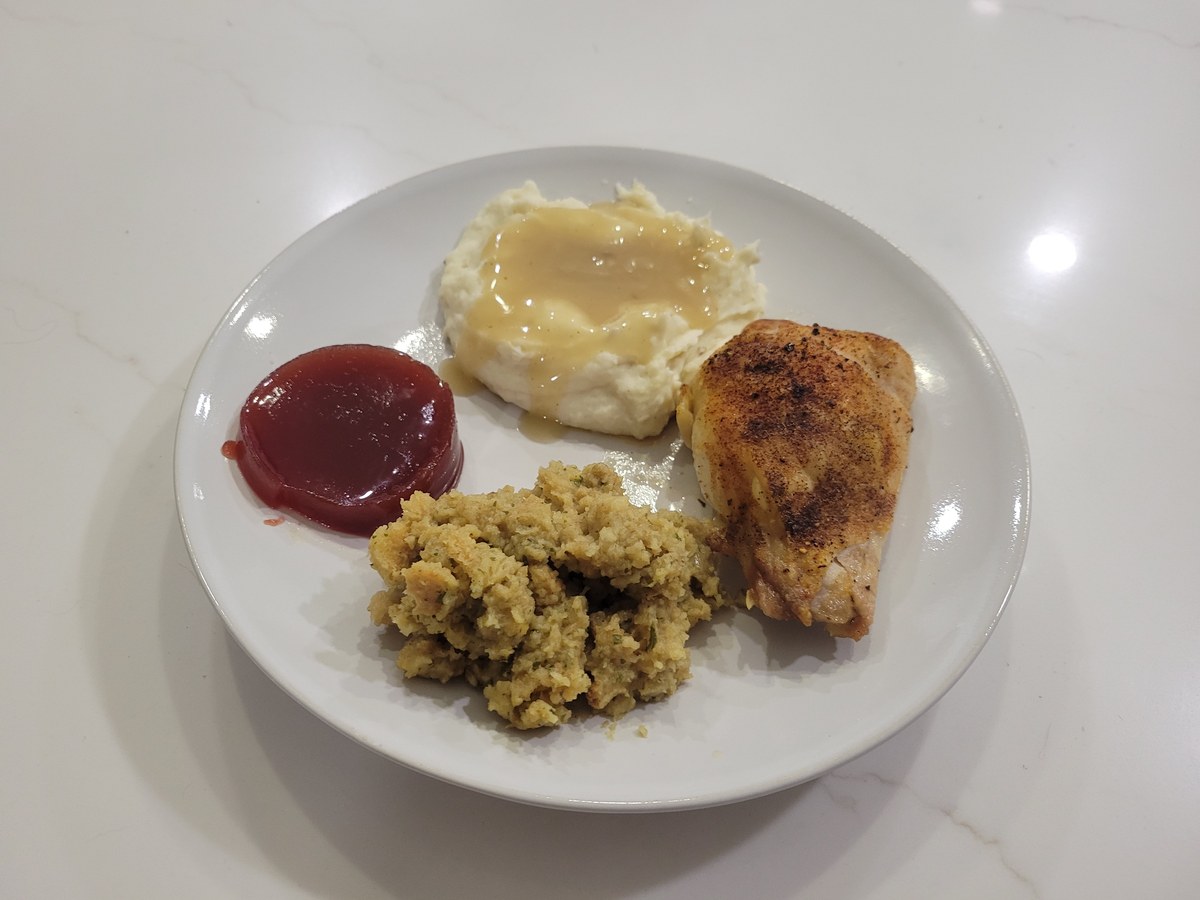
- Plate. A thigh (or two, I'm not your doctor), a scoop of stuffing, a scoop of mashed potatoes, gravy over the potatoes and the chicken, a slice or spoonful of cranberry sauce on the side (not on top of anything — it is doing its own thing on its own corner of the plate). Serve immediately. The skin stops being crisp the second it meets the gravy, so pour the gravy over the chicken LAST and get the plate to the table before it has time to think about it.
You Could Have Made Thanksgiving. You Didn't.
Let's start with the premise. It's November. You want the Thanksgiving feeling — the roasted-poultry smell, the carb coma, the specific comfort of a plate where everything is beige. But you couldn't be bothered to brine a turkey for 24 hours, spend $140 on sides, or get the roasting pan down from on top of the fridge. So here we are. Fanksgiving is a 45-minute workaround for about 80% of the actual holiday feeling, and if that math works for you, you're in the right place. Nobody is judging you. (I am a little bit judging you. But I'm also feeding you, so we're even.)
Pat It Dry Or Suffer
This is the step people skip, and it is the single biggest determinant of whether your chicken skin is going to be the deep-amber, shattering-crisp thing you're picturing or the flaccid gray disappointment you'll actually get. Wet chicken skin cannot brown. The water has to evaporate off the surface before any browning starts, and every minute your oven spends drying the surface is a minute it's not crisping it. Paper towels. Front and back. Press, don't rub. Then oil. Then season. In that order. Skip this and your chicken skin will come out the color and texture of a wet post-it note. You have been warned. If I see pale rubbery chicken skin at Fanksgiving, I am going home.
The Rack Is Not Optional
I know you're tempted to skip this. You're thinking: it's chicken, it's a sheet pan, how different can it be? It is completely different. On a flat sheet pan, the thighs sit in their own fat as it renders, and the undersides of each thigh poach in that puddle. The underside of your chicken comes out gray and limp, no matter how crisp the top is. On a wire rack set over the sheet pan, hot air circulates all the way around every thigh and the rendered fat falls through to the pan below — so you crisp evenly, top AND bottom, and the fat doesn't braise the bottom of your chicken into mush. A cheap wire rack is $8 at any grocery store. Buy one. This is not where you cut corners.
Boxed Stuffing. No Apologies.
Fanksgiving is a lazy meal. We are not pretending otherwise. Stove Top. Pepperidge Farm. Whatever's on the shelf at the store you walked into. Follow the directions on the box. Boxed stuffing from a brand that has been doing this for 50 years is better than homemade stuffing from someone who has never made stuffing before, and that someone is you tonight. The ONE upgrade move: brown half a stick of butter in a small pan until it smells nutty and the milk solids go golden, then use THAT butter when you make the stuffing. Takes 90 seconds. Tastes like you spent an hour. Nobody has to know.
Don't Cheap Out On The Potatoes
The potatoes are the one thing on this plate carrying the whole "Thanksgiving" claim. Don't phone them in. Make real mashed potatoes from the Thanksgiving Mashed Potatoes recipe. Not instant. Not the pouch in the frozen aisle. Not the fully-cooked tub in the refrigerated section that costs $9 and tastes like glue. Russets or Yukon Gold, peeled, boiled, drained well, mashed with real butter and real salt — and then 2-3 Tbsp of heavy cream per pound of potatoes folded in at the end. Heavy cream is the Fanksgiving upgrade. A splash. Not a cup. Just enough to make them taste like you tried, even though you absolutely did not. If someone at the table asks what's in these, you say "love." They don't need to know it's heavy cream and self-loathing.
Jarred Gravy. Do Not Be A Hero.
I know what you're thinking. You put the chicken on a rack. The drippings pooled in the sheet pan. You could make a from-scratch pan gravy right there, roux and stock and the whole thing, in about eight minutes. And you absolutely could. On the actual holiday, you should. But this is Fanksgiving, and Fanksgiving has one rule: take the shortcut. If you start making roux-based gravy from drippings, the next thing you do is make stuffing from scratch, and then you're brining a turkey, and now we're having Thanksgiving. Which we already said we weren't doing today. Buy a jar of gravy. Dump it in a small saucepan. Warm it up. Pour it on the plate. Heinz, Pacific, store brand — any of them is 85% as good as what you'd make, and this entire meal is an 80% effort to begin with. The jar is on-brand. Save the real pan gravy for the real holiday.
Cranberry Sauce Makes The List (Under Protest)
Full disclosure: I don't like cranberry sauce. I never have. It is cold and sweet and jiggly and shaped like the can it came out of, and the ridges from the can's inside wall are the only texture it has going for it. I would rather drink the brine from a jar of pickles. BUT — cranberry sauce is a Thanksgiving plate requirement for a lot of people, and this is Fanksgiving. The whole point is to deliver the Thanksgiving feeling, not my personal preferences. So the cranberry sauce makes the list. It is on the list exactly as it comes out of the can. I will not be making it from scratch, I will not be jazzing it up with orange zest or port or whatever people do when they're pretending to care about cranberry sauce. One can. One plate. Slice it. Put it on the side. If you love it, great, you're making this plate better than I would. If you don't, slide it off onto my plate and I'll have exactly the same reaction I always do, which is: no thank you. Pass the gravy.
What's Missing
Let's be honest about what you're not getting. No turkey — chicken thighs, we agreed. No pie — go buy one. No sweet potatoes — next time. And no green bean casserole — and I will fight anyone who skips Fanksgiving in protest of a missing green bean casserole. It is a canned-mushroom lasagna with onions on top. Come on. What you've got on the plate: thighs, stuffing, mashed potatoes, jarred gravy, and (under protest) a slice of cranberry sauce. 80% of the feeling now. About 45 minutes of work. Fine.