Ingredients
Makes 2 servings, about 24 oz total. The ratio is 2/3 solids to 1/3 liquid by volume — scale up or down, keep the ratio.
Instructions
- Liquid in the blender FIRST. Orange juice and pineapple juice go straight into the blender pitcher before anything else. This is a real technique thing, not a preference: the liquid at the bottom lets the blades pull the frozen fruit down into the cut instead of just spinning around it and forming a stuck ice ball while the motor whines. Skip this step and you'll spend the next five minutes stopping the blender and poking things with a spatula. Do it in the right order and it just works.
- Banana next. Peel it, break it into a couple of chunks, drop it in. It goes on top of the juice and under the frozen fruit. The banana is doing the emulsifying — it's the reason a smoothie is creamy and not a fruit slush — and it needs to be in the middle of the pile to do its job.
- Frozen fruit on top. Strawberries first, then blueberries. Raspberries too if you're using them and haven't discovered you're allergic (see the sidebar). Piling the frozen stuff on top is deliberate: gravity pulls it down into the blades as they turn, instead of it floating on juice while the blender screams.
- Blend on high. If it has chunks, blend more. It is impossible to over-blend this. Make it smooth. Ramp up from low for the first few seconds so the blades get purchase on the fruit, then it's high the rest of the way. Not medium. Not "pulse a few times and see." HIGH. The finished target is uniformly smooth throughout the glass — no discernible bits of berry skin or banana. If you can see chunks through the glass, blend it another 30 seconds and pour again. If the blender is whining but the fruit isn't moving, stop, poke the fruit down with a spatula, restart on low, ramp back to high.
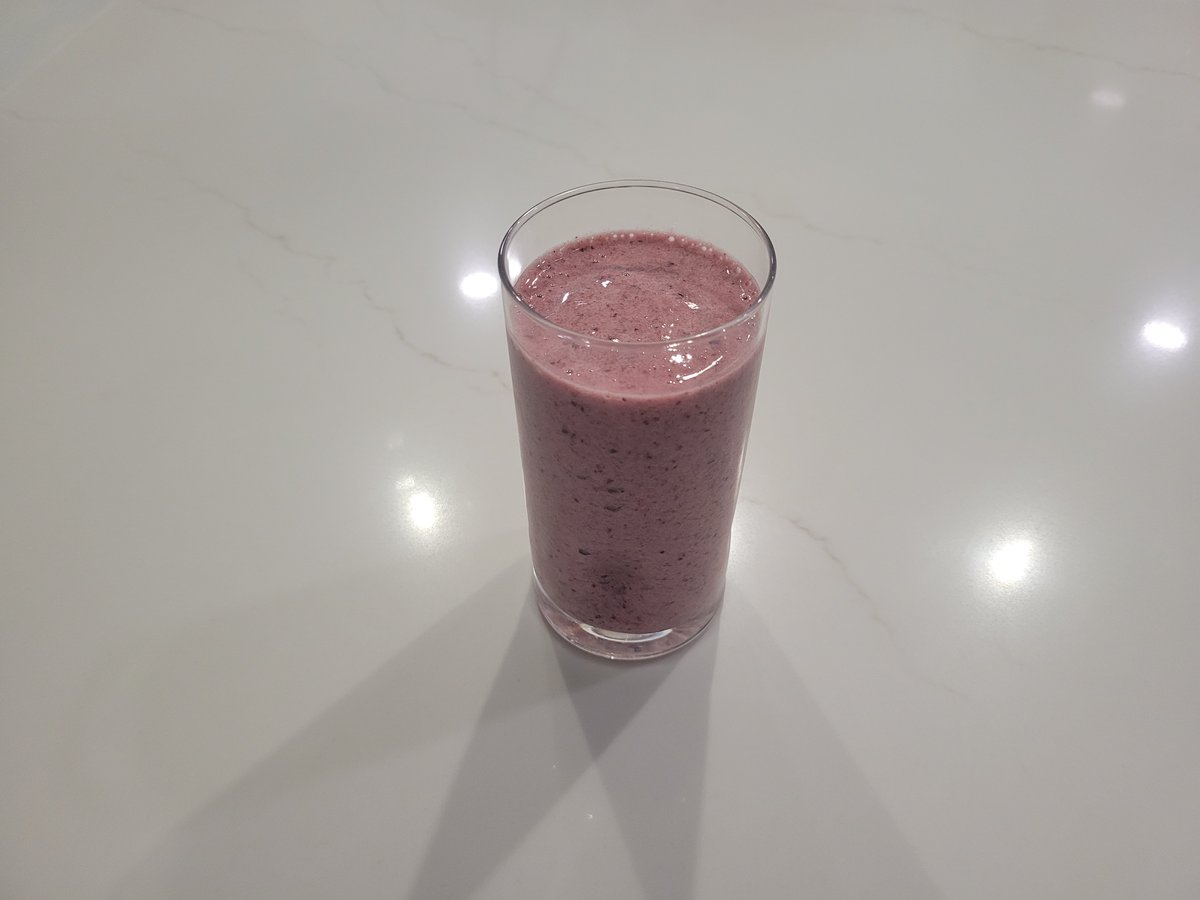
- Pour into a tall glass. Drink. No straw discourse, no topping, no artful garnish, no dusting of chia seeds or coconut flakes for the photo. It's a smoothie. Drink it now while it's cold; it does not improve with time.
The Proportion Is the Whole Recipe
Aim for two-thirds solids to one-third liquid by volume. That's it. That's the recipe. Individual amounts of strawberry vs. blueberry vs. banana are up to your taste; the ratio is not.
Too many solids and you eat your smoothie — it's too thick to drink, you're spoon-scraping cold fruit paste out of the glass, and at that point you've made frozen yogurt without the yogurt. Too little and it isn't a smoothie at all — it is fruit juice, and fruit juice was already invented. The window is narrow but the range within it is wide: hit 2/3-to-1/3 and everything works, drift outside it and nothing does.
No Ice. Frozen Fruit Only. This Is Not Negotiable.
No ice bullshit. That waters it down quickly. If you want a piña colada, make that instead.
Ice adds cold but subtracts flavor as it melts, and by the time you finish drinking it, the last third of your smoothie is diluted pink water. Frozen fruit does both jobs at once — it keeps the drink cold AND it adds flavor as it thaws. This is a free upgrade. Buy the frozen berries. They cost the same as fresh, they last a year in your freezer, and the strawberries you were going to buy fresh were going to turn to mush in three days anyway.
The chain smoothie shops use ice because ice is free and fruit is not. You are not running a chain smoothie shop. Use the fruit.
Fresh Banana, Not Frozen
The banana is the binder. It emulsifies the liquid and the frozen fruit into that smooth, creamy texture that makes a smoothie feel like a smoothie instead of a slush. A fresh, room-temperature banana at the right ripeness — yellow with a couple of brown speckles, not green and not black — does this perfectly.
Frozen banana works, but changes the game: thicker, more like a milkshake, banana flavor comes forward, and you can practically eat it with a spoon. If that's what you want, go for it — that's a legitimate variation, not a mistake. But this recipe is calibrated for fresh, and swapping to frozen banana without adjusting the liquid up will land you at "eat your smoothie" territory. See the proportion callout.
A Word About Raspberries
If you want raspberries, make them be frozen as well. I don't add those because I'm apparently allergic to them. I know, who knew you could be allergic to raspberries?
Turns out plenty of people. Raspberry allergy is a real thing — for a lot of folks it's a cross-reaction called oral allergy syndrome, where the immune system confuses raspberry proteins with birch pollen and picks a fight with your mouth. Genuine IgE raspberry allergy exists too, it's just rarer. Symptoms are usually itchy mouth, tingling lips, maybe some throat scratchiness — annoying but generally not dramatic. Anyway. If you can eat raspberries, add them (frozen). If you can't, skip them. The recipe is complete without them.
What NOT to Add
Protein powder. Green powder. Spirulina. Açaí packets. Chia seeds. Flax seeds. "Collagen peptides." MCT oil. A scoop of anything that comes in a tub with a bodybuilder on the label. Ashwagandha. Maca powder. Beetroot powder. Whatever bee pollen is.
This is a fruit smoothie. Fruit is the ingredient. Adding a scoop of green sludge doesn't make it healthier — it makes it taste like grass with fruit ambitions, and you end up spending $40 on a jar of powder to ruin a $3 drink. If you need protein, eat some eggs. If you want fiber, eat a vegetable. If you're trying to make a smoothie work as a meal replacement, it isn't one, and no amount of powder is going to change that.
The smoothie bowl thing — where you pour this into a bowl and top it with $18 worth of granola, coconut flakes, chia seeds, and neatly-arranged dragon fruit slices for Instagram — is the same trick with a bigger prop budget. It is still a fruit smoothie. It just costs eighteen dollars now.
Blend On High. Chunks Are the Enemy. You Cannot Over-Blend This.
Blend on high. If it has chunks, blend more. It is impossible to over-blend this. Make it smooth. That's the whole technique. The rest is footnotes.
The low-to-high ramp is only for the first few seconds — long enough for the blades to get purchase on the fruit and start pulling things down into the cut. After that, the whole rest of the blend is on high. Not medium. Not "on low because it's loud." Not "pulse a few times and see how it looks." HIGH.
Chunks are the enemy. Visible chunks in the finished smoothie mean you didn't blend long enough. You will find them later by hitting a frozen berry with a straw and feeling like you just bit a rock, and at that point it is too late; you cannot go back and blend the glass. Blend the pitcher until there are no chunks.
You cannot over-blend a smoothie. Unlike whipped cream (which turns to butter) or bread dough (which turns to a chewy brick), there is no "went too far" state for a smoothie. It will just get smoother. Keep going until it's smooth. If the blender motor gets hot — and cheap blenders will — give it a 30-second break, then keep going. Nothing is being ruined by more blending. Chunks are being ruined by less.
The finished target is uniformly smooth throughout the glass — no discernible bits of berry skin, no banana lumps, no strawberry seeds you can pick out. Pour a test glass. Hold it up. If you can see chunks through the glass, dump it back in and blend another 30 seconds. Pour again. Repeat until smooth. That's done.
The Blender Loading Tip That Actually Matters
Liquid first, banana second, frozen fruit on top. That's the loading order in one sentence.
Why the order: the blades sit at the bottom of the pitcher. Whatever's down there is what they engage first. Put frozen fruit at the bottom and the blades whack it once, it wedges into an ice ball, and now the motor is spinning against a rock while the top of the pitcher sits there untouched. Put liquid at the bottom and the blades create a vortex that pulls the fruit down into the cut. Same blender, same ingredients, completely different result.
If mid-blend the machine is whining but the fruit isn't moving, you've got an air pocket and the blades are spinning in nothing. Stop, poke the fruit down with a spatula, restart on low, ramp back to high. Repeat if needed. Cheap blenders will pretend to be expensive blenders for years using this trick.
The Money Angle (Brief Aside)
A single 20 oz smoothie at Jamba Juice, Smoothie King, or Robeks runs eight to ten dollars. This recipe makes two of them for about three bucks in ingredients. That is not a fair price gap; that is a shakedown, brought to you by a small industry that has collectively decided fruit and a blender are somehow worth eight dollars a cup.
Buy the fruit. Buy the juice. Blend. Save six bucks per drink, which over a summer of smoothies is a very serviceable dinner out.