Ingredients
The Salmon
The Topping That Made Us Call This Bruschetta
Instructions
- Preheat the oven to 400°F. Line a sheet pan with parchment or foil. This is a one-pan dinner if you don't count the bowl, and we're not going to count the bowl.
- Pat the salmon dry. Paper towels. Both sides. If you don't dry the salmon, the salmon does not dry itself. This is not negotiable. I do not know how else to phrase this. Wet salmon steams instead of browning, and you didn't come this far to make sad gray fish. Brush each filet with olive oil, then season both sides with the salt and pepper. Place skin-side DOWN on the sheet pan. The skin-down thing matters in step 6; trust me now and you'll thank me then.
- Bake 12-15 minutes. 12 for thinner filets (about 3/4" thick), 15 for thicker (about 1.25"). If you have a probe thermometer — and you should — you want 125-130°F at the thickest part for silky / medium, or 140°F if you like it fully cooked through. No thermometer? The fork-flake test: nudge the thickest part with a fork. If the flakes separate easily, it's done. If it still looks translucent and gummy in the middle, give it another two minutes. Salmon thickness varies wildly, which is why the time is a range and not a number.
- Meanwhile, build the topping. Combine the diced tomatoes, red onion, and basil in a small bowl. Pour the balsamic over and stir gently. Let it sit for the 10-12 minutes the salmon is in the oven. The vinegar pulls the bite off the raw onion and pulls the juice out of the tomato, and the whole thing turns into a glossy little relish while you do nothing. This is the laziest, highest-leverage step in cooking.
- Dice the avocado LAST. Right before the salmon comes out. Cut avocado oxidizes faster than your phone battery, and balsamic accelerates the disaster. Do NOT add the avocado to the balsamic bowl. If you add balsamic to the avocado, your avocado will be fucked. Full stop. That's the entire warning. Cube it on your cutting board and leave it on the cutting board until plating — the bowl is not a holding area, it is a trap.
- Pull the salmon out and skin it the lazy way. Slide a fish spatula (or two forks) between the flesh and the skin. The skin sticks to the parchment, the filet lifts off clean and skinless. If you actually want crispy skin, that's a pan-seared salmon recipe, not this one — this is the "I want dinner in 25 minutes" school of salmon. Eat the skin separately if you must, or throw it out and feel nothing.
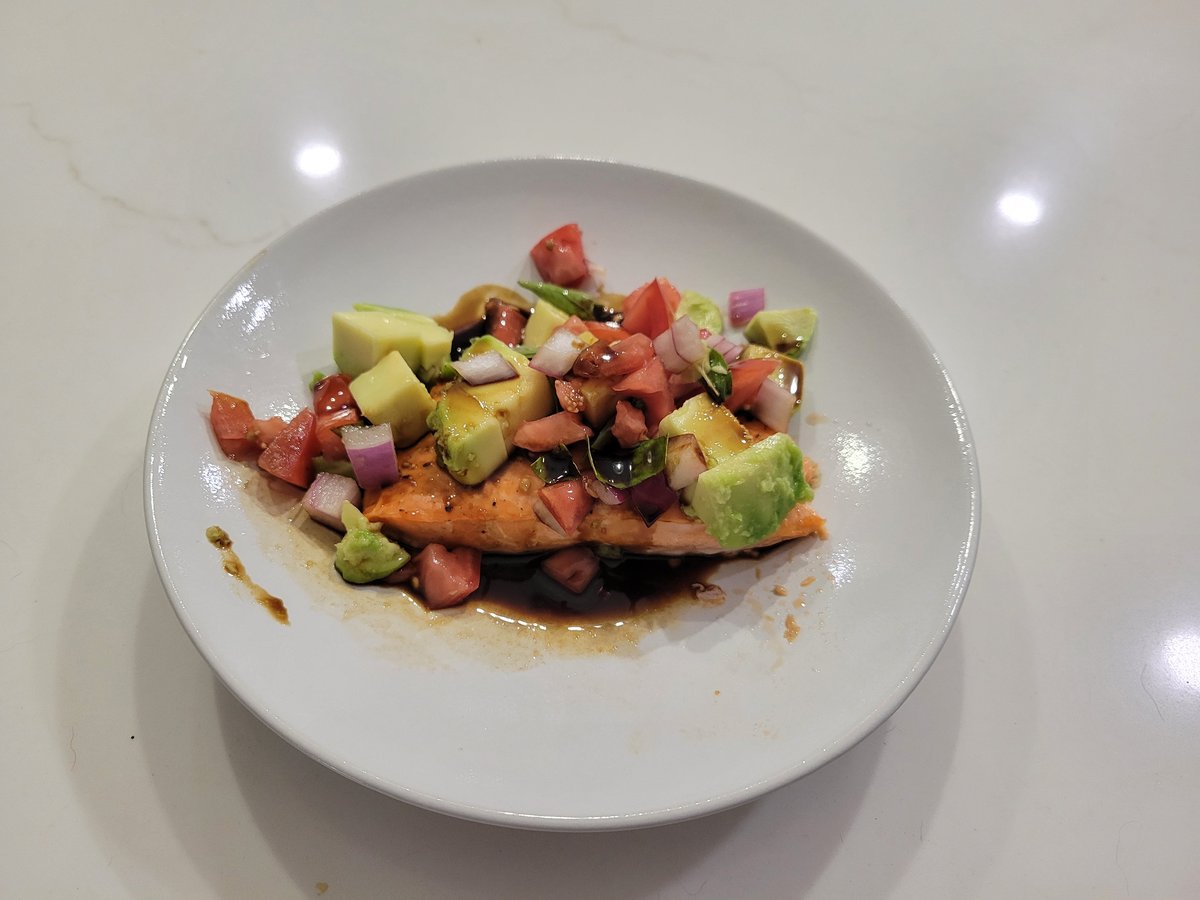
- Plate. Salmon filet on a plate. Spoon the soaked tomato-onion-basil mixture over the top in a generous mound. Scatter the diced avocado over and around. Drizzle any leftover balsamic from the bowl around the plate like you do this for a living. Eat immediately, while the salmon is still warm and the topping is still cold and the avocado is still green. Every minute you wait, the avocado loses a little dignity.
About the Name (We Need to Talk)
The word "bruschetta" comes from the Italian bruscare, which means "to roast over coals." The entire reason this dish has its own name — the reason it isn't just "tomato salad on bread" — is the toasted bread. The bread is the noun. The bread is the dish. The chopped tomato is a topping for the bread. That's the deal. That's always been the deal.
This recipe has no bread. It also has no cheese, which is the other thing people sometimes mean when they say bruschetta. What it has is salmon with a chopped relish on top. Calling that "bruschetta" is calling a sandwich a "bread pizza." It is calling a hot dog a sausage taco. It is, linguistically, completely unacceptable.
And yet. Here we all are. You searched for this recipe. You knew what it was called. You're going to make it. You're going to put it on a plate and serve it to people and tell them, with a straight face, that it's bruschetta. So am I. We are co-conspirators against the entire concept of food etymology, and the only honest thing left to do is admit it. You don't get to be smug about this. You're not above this. You're a person who searched the internet for "salmon avocado bruschetta," and now you're reading the part where I explain to you that bruschetta means toasted bread. You're in it with the rest of us.
The Avocado Rule (The Only Rule)
If you add balsamic to the avocado, your avocado will be fucked. That should be enough. It is somehow not enough. So: avocado does not go in the balsamic bowl. Ever. Vinegar plus cut avocado equals brown mush — every single time, no exceptions, no special vinegar, no special avocado, no "but mine will be different." Dice the avocado the moment before plating. Scatter it on top. Do not "just toss it in to save a step." Do not "see how it goes this time." If you remember nothing else from this entire page, remember this. It is the one rule. It is the only rule. I am tired of explaining it.
Pat It Dry, Oil It, Skin-Side Down
These are not techniques. Stop bragging about them. Patting the salmon dry, brushing it with oil, and laying it skin-side down on parchment are the absolute minimum — the price of admission for cooking salmon at all. Wet salmon steams. Dry salmon browns. Oiled salmon doesn't weld itself to the pan. Skin-side-down on parchment lifts off skinless without you doing anything else. None of this requires skill, equipment, or a "tip." You do these three things and you have not earned applause; you have merely cleared the lowest possible bar. The day someone praises you for patting salmon dry, you should both be embarrassed. And if you're posting any of this to TikTok as a "salmon hack," please stop. These aren't hacks. These are instructions. There is no shortcut here. There is no secret. There is a paper towel.
Internal Temp Matters More Than Time
Salmon filets vary wildly in thickness — a thin tail piece and a thick belly cut from the same fish can be a half-inch apart, and the same oven time will leave one perfect and one bone-dry. A $15 probe thermometer fixes this forever. If you cook salmon more than twice a year and you still haven't bought one, you are choosing to ruin a $30 piece of fish to save $15, which is bad math, and I cannot help you. 125-130°F at the thickest part for silky / medium, 140°F for fully cooked-through. If you absolutely refuse to spend fifteen dollars on the one tool that makes this foolproof, the fork-flake test works: nudge the thickest part with a fork; clean flakes means done, gummy or translucent in the middle means another minute or two. The clock is a suggestion. The temperature is the truth.