Ingredients
The Pasta and Veg
The Sauce
The Scallops (The Whole Point)
Instructions
- Get the water going. Big pot of well-salted water on to boil, like the sea, whatever the cliché is. This runs in the background while you do everything else. Do not stand and watch it. You have prep to do.
- Prep everything before you touch a burner for real. Halve and slice the zucchini into 3/4-inch half-moons. Wedge the tomatoes. Quarter the mushrooms and keep them in their own pile — they get their own pan, and mixing them in with the other veg here means you'll grab them all together later. Mince the garlic. Zest both lemons into one small pile; juice them into a separate small bowl. Slice the chives. Take the cream cheese out of the fridge so it's not a cold brick when it hits the pan. Pat the scallops dry with paper towels — both sides. This is not optional. See the callout.
- Mushrooms in butter, own pan. Melt 1 Tbsp of the butter in a small skillet over medium-high heat. Add the mushrooms and a pinch of salt. Let them sit for a minute before stirring so they actually brown instead of steam, then cook until they're golden and their liquid has cooked off — 6 to 8 minutes. Kill the heat and set the pan aside. Mushrooms cooked with the other vegetables end up gray, watery, and taste like disappointment. They get their own pan. See the callout.
- The linguine goes in the boiling water right around the time the mushrooms hit their pan. Cook 9 to 11 minutes to al dente. Reserve 1 cup of pasta water before you drain. Do not skip the reserve. Do not skip the reserve. Do not skip the reserve.
- Zucchini and tomato in the big pan. In a large skillet over medium-high heat, warm the olive oil. Add the zucchini and a pinch of salt. Sauté 4 to 5 minutes until it starts to take on some color and lose its raw crunch. Add the tomato wedges and cook another 2 to 3 minutes — softened, not disintegrated. Reduce the heat to low and add the minced garlic. Stir it into the veg for about 30 seconds, just enough to bloom, not enough to burn. Burnt garlic is bitter garlic, and no amount of butter will save it.
- Build the sauce in the pan. Push the veg to the sides. Add 2 Tbsp of the butter to the middle of the pan, then the softened cream cheese, half the chives, all the lemon zest, and a splash of pasta water. Stir the cream cheese into a smooth, glossy base — if it looks lumpy or curdled, add more pasta water and keep stirring; this is why the cream cheese needed to be soft. Add the Parmesan and a bigger splash of pasta water. Stir until it's a creamy sauce coating the veggies. Return the mushrooms to the pan.
- Add the drained linguine. Toss until every strand is coated. If the sauce looks tight, more pasta water. If it looks loose, keep tossing — it'll come together. Squeeze in the juice of one lemon (start with one; you can add the second at the table). Taste. Salt if it needs it, pepper for sure.
- Sear the scallops. Last thing. Not first, not middle. LAST. In a separate hot skillet over high heat, melt the last 1 Tbsp butter. Pat the scallops dry AGAIN — any moisture that's come out while they sat is going to fight you in the pan. Season with salt and pepper. Lay them in the hot pan — don't crowd them, work in batches if you have to — and DO NOT MOVE THEM for 2 minutes. Flip. Another 2 minutes. That's the whole cook. Four minutes total. This is at the end because we don't like eating rubber.
- Plate. Linguine into bowls or shallow plates. Top each with the seared scallops, the remaining chives, and a wedge of lemon on the side. Serve immediately. Do NOT let the scallops sit under a cover on top of the hot pasta — they will keep cooking and you will have eaten rubber after all, and the last four minutes of your life will have been for nothing.
The Scallops Are the Whole Point. Do Not Fuck Them Up.
Dry-packed scallops (no phosphates) sear properly. Wet-packed scallops — the ones sitting in cloudy liquid at the seafood counter — release water in the pan and steam instead of brown, and then you're eating a gray hockey puck that used to be a scallop. If your seafood counter has both, buy dry-packed. If they only have wet-packed, pat them dry twice as hard and press them lightly between paper towels for a couple of minutes before searing. High heat. Two minutes. Flip. Two minutes. That is the whole cook. A scallop that has been "kept warm" is a scallop that has been ruined. This is at the end because we don't like eating rubber.
Shrimp version: pat dry, high heat, 90 seconds per side. Same rule, just faster. When they curl into a loose C, they're done. When they curl into a tight O, they were done a minute ago and you owe them an apology.
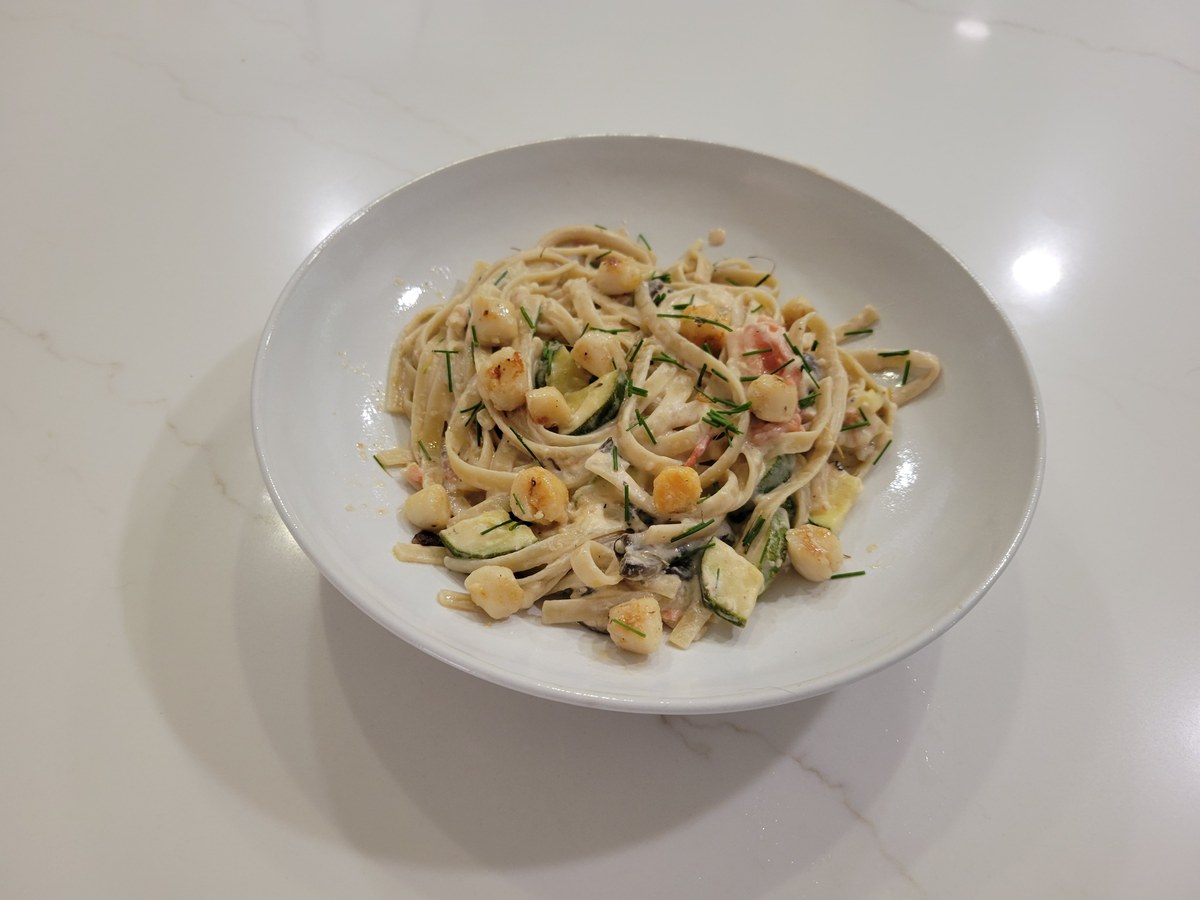
Bay scallop version: the small round ones. Sweeter, milder, faster. Same rules on higher heat — 90 seconds a side, don't move them, done. A fair swap if the counter is out of the big sea scallops or you just prefer the smaller ones. (They're what's in the photo above, in case you were wondering where the big discs went.)
Mushrooms Get Their Own Pan. This Is Non-Negotiable.
Mushrooms release a startling amount of water when they cook. In a pan with zucchini and tomato, that water dilutes everything, the sauté turns into a steam, the whole pan turns gray, and the mushrooms — which should be brown and glossy and buttery — become sad water sponges that will remind you, at every bite, of what could have been if you'd used two fucking pans. Separate pan. Butter, not oil. Medium-high heat. Salt them AFTER they start browning so the salt doesn't pull out more water. Let them sit before stirring. Then they rejoin the party at step 6 with all the flavor and none of the swamp.
Cream Cheese in Pasta Sauce Sounds Weird. It Works.
Some readers will see "cream cheese" in a pasta sauce, clutch their pearls, and go looking for a "real" recipe with heavy cream. The pearls can go back where they came from. Cream cheese melts into a silky, tangy, cohesive base that clings to pasta better than half-and-half and doesn't split when it hits acid, which matters here because there's a lot of lemon coming. What DOES matter is temperature: cold cream cheese hits the pan and seizes into a lump, and now the sauce is fucked before it started. Take it out of the fridge when you start prep. By the time you need it, it'll be soft enough to stir into the pan in about ten seconds.
Reserve the Pasta Water. Say It With Me.
One cup, minimum. Ladle it out into a heatproof measuring cup BEFORE you drain the pasta, because the moment you tip the colander into the sink, you can't get it back. Salty, starchy pasta water is the difference between a sauce that clings to every strand and a sauce that puddles at the bottom of the bowl. Every pasta recipe on this site says this. It is not a suggestion. It is the whole game. If you forget, your only recourse is boiling more water with a lot of salt, which is not the same thing and everyone at the table will know.
Lemon Is the Whole Personality of This Dish.
Two lemons. Zest goes in the sauce (bright, floral, up front). Juice goes at the finish (tart, sharp, cuts the cream). Start with one lemon's worth of juice, taste, add more from the second if it needs brightening. A pasta sauce that tastes flat is almost always a pasta sauce that needs more lemon — or more salt, but usually more lemon. The second lemon on the plate isn't garnish; it's insurance for the person at the table who takes one bite and reaches for it without saying a word.