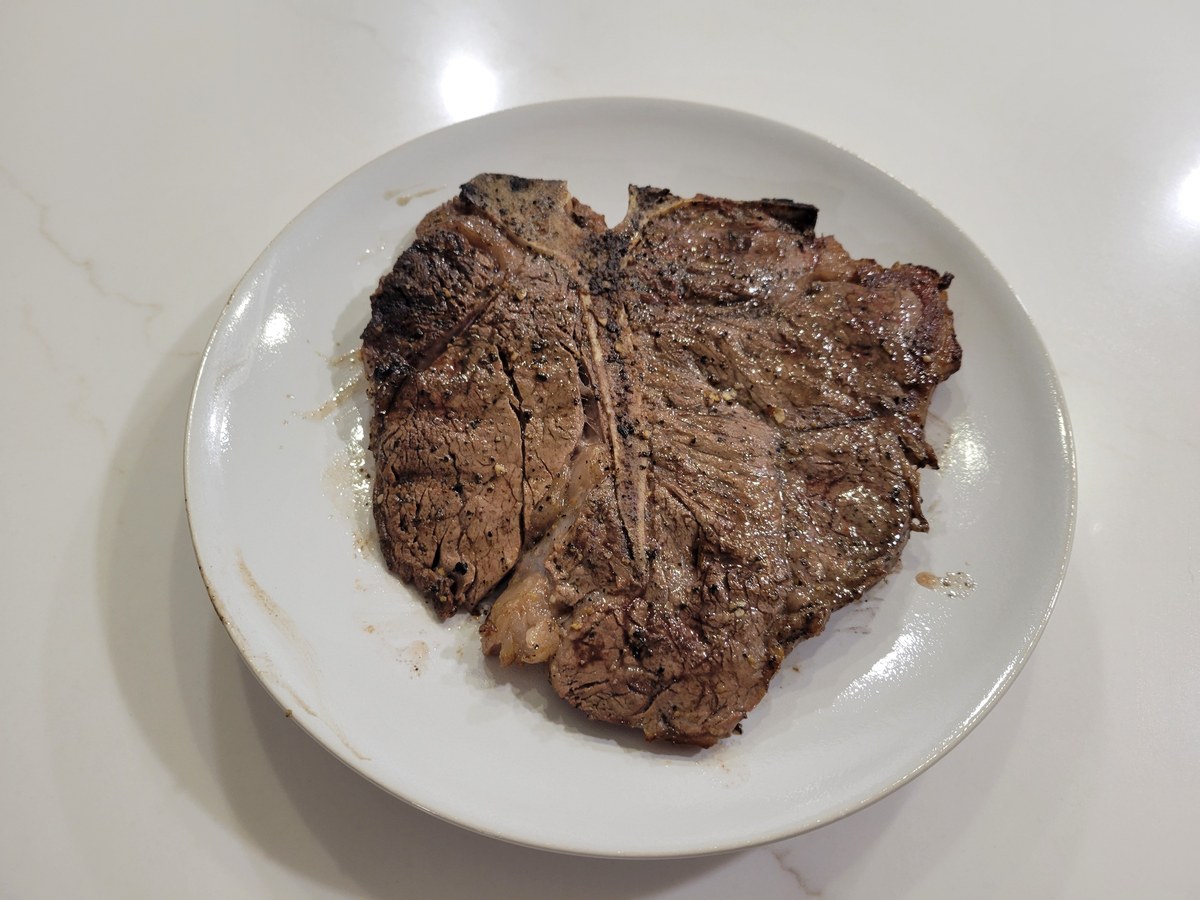
Ingredients
Sized per steak. Scales trivially — three steaks, same everything, three times.
That is the entire shopping list.
The Three Tricks (Learned in IT at Outback)
Trick 1: Marinate as Long as Possible
Morning-of is good. Night before is better. Method: steak into a gallon Ziploc, shake steak seasoning onto both sides, add the Italian dressing — less than you'd think, a few tablespoons per steak, not a full pour. The steak needs to be coated, not swimming. Seal the bag, mush the whole thing around so every surface makes contact, and put it in the fridge until you're ready to cook. Overnight is the real play. Morning-of is the fallback for when you didn't plan ahead, which happens, and it still works, just not as well.
Trick 2: It Is Hard to Over-Season Steak
Whatever instinct is telling you to hold back — ignore it. Steak wants seasoning. The crust IS the flavor. At Outback, they used to joke that they would try to get it sent back for being over-seasoned. Nobody ever did. The steak swallows it. Season boldly. If you look at your steak and think "that's too much," you're probably in the correct range. If you look at your steak and think "that's about right," you are almost certainly under. Go heavier.
Trick 3: For Different Doneness, Use Different Thickness — Not Different Cook Times
This is the pro insight, and it will change how you buy steak forever. If you cook every steak the same way (1 minute high-heat sear per side, then 6-8 minutes per side at medium-low), the ONLY variable that decides doneness is the thickness of the meat. Thinner steak = more done, because the heat reaches the middle faster. Thicker steak = rarer, because the mass insulates the center. Rough guide:
- ~3/4 inch: well done to medium-well
- ~1 inch: medium
- ~1.25 inch: medium-rare
- ~1.5 inch: rare / medium-rare
- 2 inches or more: you need a different method (probably reverse-sear); this method is built for 1 to 1.5 inch steaks
Buy the thickness that matches how you want it cooked. Ask the butcher to cut it thick or thin — that's what they're there for. This is one of those tricks that seems obvious once you hear it and revolutionary right before you did.
Instructions
- Pull the steak out of the fridge 30 minutes before you cook. Let it come toward room temp. Cold steak from the fridge cooks unevenly — the outside overcooks trying to drag the middle up to temperature. If you forgot, don't panic; the method still works, just a hair less perfectly.
- Heat the grill as high as it goes. All burners on high, lid down, 10-15 minutes. You want the grates screaming — high 500s°F or hotter if your grill can hit it. This is not the time to preheat halfway.
- Steak on, lid down, 1 minute. Do NOT open the lid. Every peek dumps heat. The steak is searing side 1. Trust it. Set a timer if you need to.
- Flip once. Close the lid again, 1 minute more. Side 2 gets its sear.
- Turn the grill down to medium-low. The high-heat part was to build the crust and lock in the moisture. From here it's about cooking through to your target temperature.
- Cook 6-8 minutes on this side, lid down.
- Flip once more. Cook 6-8 minutes on the other side, lid down.
- Pull the steak off. Total cook time is roughly 15-18 minutes for a 1 to 1.5 inch steak.
- REST IT. Tent with foil on a plate or cutting board, 5-10 minutes. Cutting into a steak straight off the grill dumps every drop of juice onto the cutting board. Resting lets the juices redistribute back through the meat. This is not optional. Do it. See the callout below.
- Slice and serve hot. Ideally with the site's Twice Baked Potatoes as a side, plus a green vegetable to make the plate look responsible.
Rest the Steak. Non-Negotiable.
Cutting into a steak the second it comes off the grill = juice all over the cutting board and a dry steak on the plate. Tent it with foil for 5-10 minutes and let the juices redistribute. This is the single biggest gap between "I grilled a steak" and "I grilled a steak correctly," and it costs you nothing but patience. If you can wait ten minutes to eat, you can rest a steak. If you can't wait ten minutes to eat, that's a different problem and this recipe cannot help you.
Doneness by Temperature
Because the method is fixed-time and variable-thickness, a probe thermometer in the thickest part is the most reliable check. Pull the steak 5°F below your target — it keeps cooking during the rest.
- Rare: 120-125°F (cool red center)
- Medium-rare: 130-135°F (warm red center — the objectively correct answer, fight me)
- Medium: 140-145°F (warm pink)
- Medium-well: 150-155°F (slightly pink)
- Well: 160°F+ (no pink; you know what you did)
What NOT to Do
- Don't cut into the steak to check doneness. That's what a thermometer or the finger test is for. Cutting = juice everywhere = drier steak. You're checking the meat by breaking the meat. Stop.
- Don't press the steak with a spatula. It squeezes out the juice you're trying to keep in. This is a Waffle House move. You are not at Waffle House.
- Don't flip constantly. Once per side on high, once at the halfway of the medium-low phase. Four total contact points. That's it. Constant flipping doesn't help; it just dumps heat every time you open the lid.
- Don't skip the rest. See above. I will know.
Serving
Pair with the site's Twice Baked Potatoes — the cheese-and-bacon-in-a-potato-skin move is what steak was invented to sit next to. Add a green vegetable (asparagus, broccoli, whatever isn't offensive) so the plate has one thing that grew in the ground. That's dinner.