Ingredients
Instructions
- Small skillet on medium heat. Nonstick is ideal. Seasoned cast iron works. Do NOT reach for the twelve-inch pan you make pancakes in — you have one egg, and a big pan makes the whites spread out into thin, dry, ragged little continents. Small pan, small egg, small problem.
- Warm the pan for a few seconds, then drop in the butter. Enough to coat the bottom of the pan in a thin film. Not a puddle. Not a scrape of butter that immediately turns brown and burns before you can crack the egg. A thin, even film of melted butter. That's the target. See the butter callout if you're still confused, because you're about to be.
- Crack the egg into the pan carefully. One hand on the shell. Crack it low, near the surface of the pan, and let the egg slide in. Do NOT crack it six inches above the pan and let gravity do it. You are not on the Food Network. You are alone in your kitchen and gravity is not your friend today — it breaks yolks.
- Cover the pan with a lid. This is the whole recipe. A lid. Any lid. The one that fits, a bigger one, a metal one, a glass one, a plate flipped on top — whatever seals it. The lid traps steam, which cooks the TOP of the whites without you flipping the egg (that's a different recipe called "over easy") and without the yolk overcooking from direct heat above. If you skip this step, none of the rest works. Not one word of it. Cover. The. Pan.
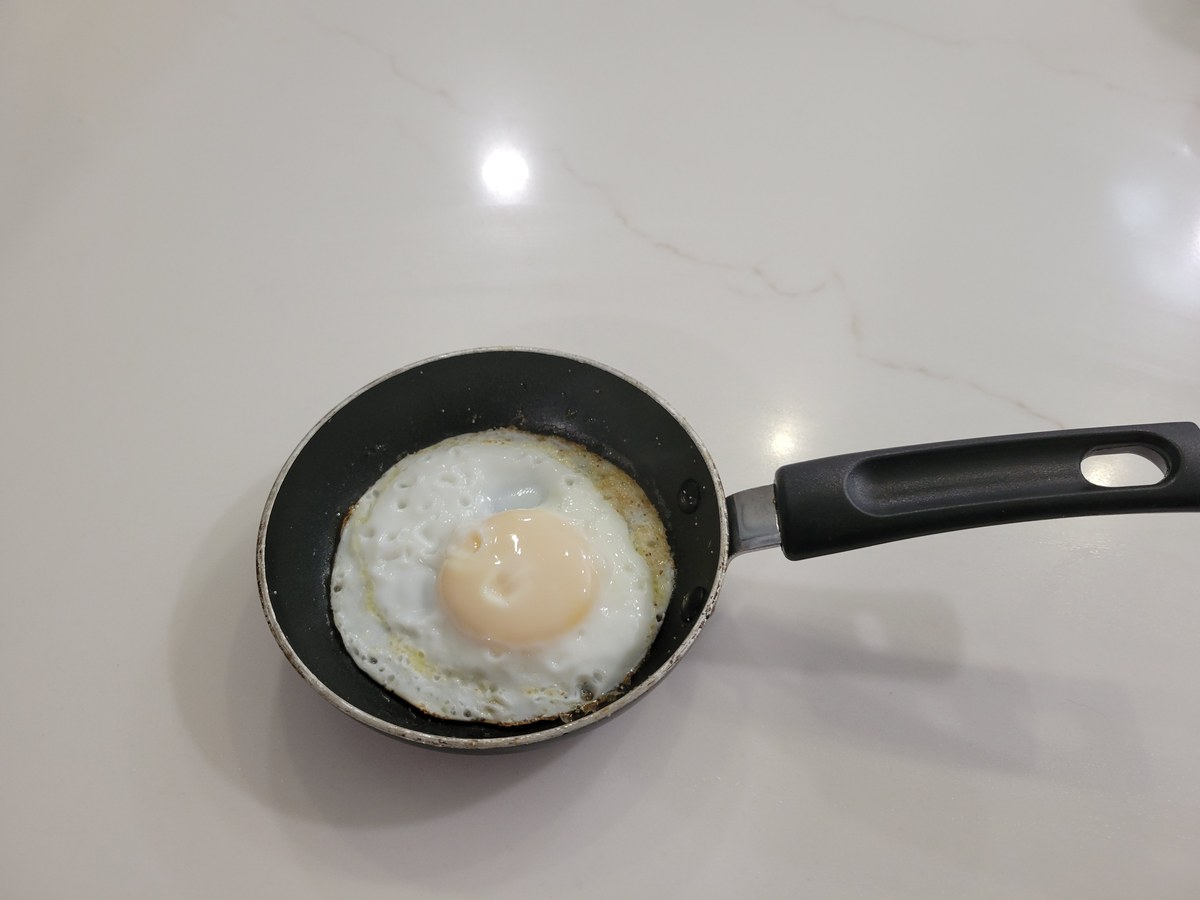
- Cook on medium heat until the yolk just films over. Usually 2-3 minutes. You're watching for a thin opaque skin to form on top of the yolk. Not a hard shell. Not a crust. A whisper of a film that turns the yolk from wet-glossy to matte. That film is the tell. When you see it, the whites underneath and around have set, and the yolk is still liquid inside. Pull it now.
- Check the whites. Peek under the lid. If there's a puddle of clear, translucent goo around the yolk, you jumped the gun — put the lid back on for another 20-30 seconds. If the whites are opaque all the way to the yolk, you're done.
- Slide the egg onto a plate. Season with salt and pepper AFTER cooking — if you salt raw whites in the pan, the salt sits in wet spots and doesn't distribute. Eat immediately. A sunny-side egg cools fast and gets sad fast. Move.
The One Rule: Cover the Pan
This is the whole fucking recipe. A lid traps steam and cooks the top of the whites without you having to flip the egg, and without cooking the yolk from above. If you're standing there over an uncovered pan watching the whites stay clear right next to a yolk that's already turning into rubber, you missed the one rule. Get a lid. Any lid that covers the pan works — glass, metal, a bigger frying pan flipped upside down, a plate. It does not need to seal perfectly. It just needs to be on top. If you take one thing away from this page, take this. If you take zero things away, at least take this one.
The Timing Cliff
Sunny-side up looks trivial and is actually one of the most narrowly-timed things in a home kitchen. The whites set slower than the yolk overcooks. You are trying to fully set the whites without hardening the yolk, and the window for landing both is small — call it 20 seconds wide. That's it. That's the whole difficulty of the dish, and it's why people who"ve been making these "forever" still end up with runny whites or a hard yolk. The tell is the film on the yolk. A thin, opaque skin means everything underneath is set. The moment you see that film, pull the egg. Wait another thirty seconds and you have a soft-boiled situation instead — which is also fine, and delicious, but that's not what's printed on the recipe card, is it.
Butter Amount (Not a Puddle, Not a Scrape)
Enough butter to coat the bottom of the pan in a thin film. Not a scrape. Not a puddle. Get this wrong in either direction and the egg suffers. Too little: a scrape of butter burns before the egg even hits the pan, welds the whites to the metal, and you're scraping charred whites off a nonstick surface at 8am wondering where it all went wrong. Too much: a shallow pond of butter that fries the edges of the whites crispy and brown, gives you a greasy little swimming pool of an egg, and defeats the whole soft-and-set thing we're trying to accomplish here. A thin, even, just-melted film. That's the amount. Roughly a teaspoon in a small skillet. Eyeball it.
You Do Actually Need a Recipe For This
Look. It's an egg in a pan. I know. You know. We all know. But sunny-side up is one of those things people cook wrong for years and just quietly eat the results — raw white slime around the yolk (didn't cover it), or a hard chalky yolk (waited too long, no lid), or an egg glued to the pan in three sticky patches (not enough butter, no lid, heat too high). If you already do this correctly every time and your eggs come out with fully-set whites and a liquid yolk, then great, congratulations, this page is not for you and I don't know why you're still reading. If not, the whole trick is the four things above: small pan, thin butter film, medium heat, LID. That's it. That's the entire skill. It takes three minutes. Please stop eating slime.