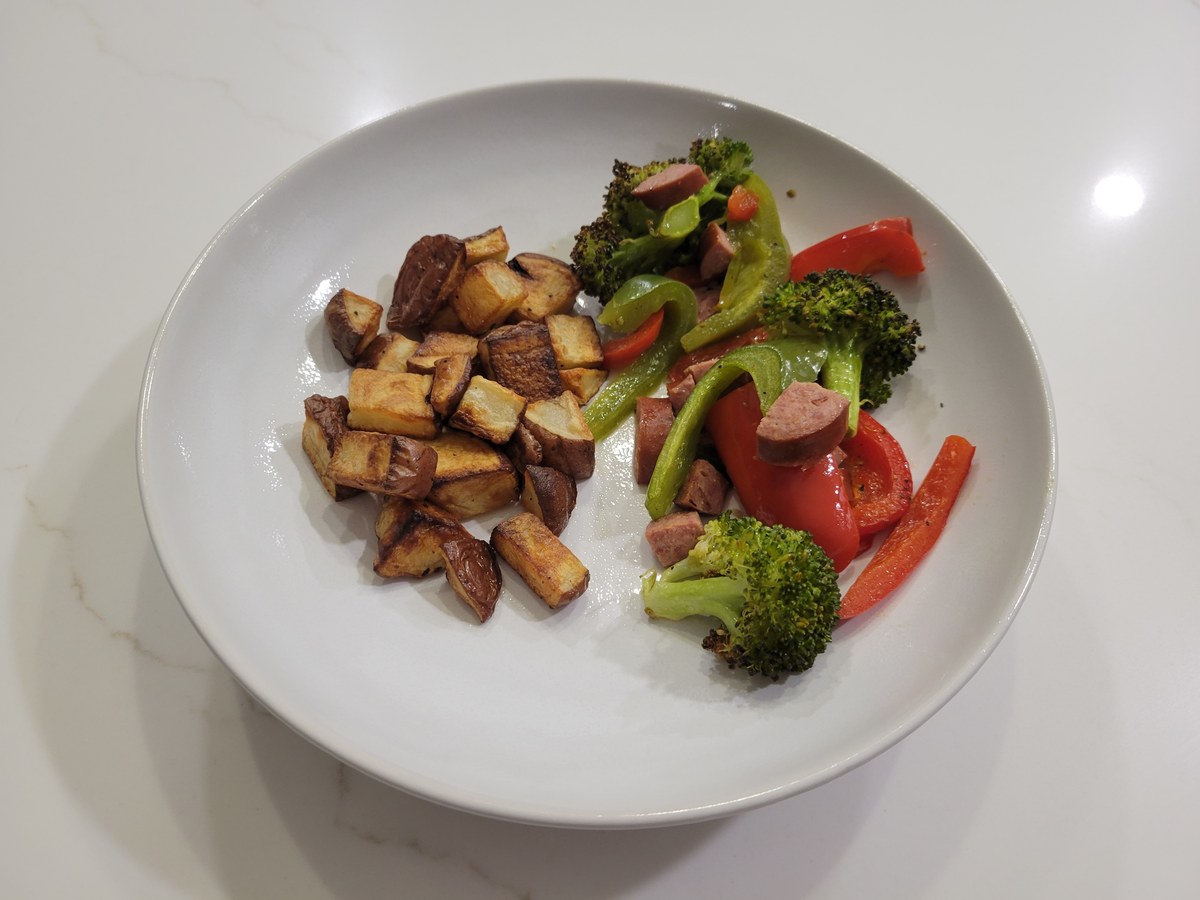
Ingredients
The Mandatory Two (Plus Seasoning)
This is the whole shopping list. If you have these five things, you have dinner.
Whatever You Have (Any Combination, or None at All)
Pick some. Three or four vegetables total is about right for a full second sheet pan — but any combination works, and "no vegetables at all, just sausage and potatoes" is a completely legitimate weeknight version. Do not go to the store for any of this. If it's in the crisper drawer, it's eligible. If it isn't, it isn't.
Instructions
- Preheat the oven to 450°F. This is a hot oven. It needs to be actually hot, not "you turned it on 4 minutes ago and started chopping." Give it a full 15 minutes to come up to temp. If you throw potatoes into a lukewarm oven, they steam themselves into wet cubes and you will be sad about it for the rest of the night.
- Wash and cut the potatoes into rough 1" cubes. Precision doesn't matter — bigger takes longer, smaller takes shorter, and you're flipping them halfway anyway. Consistent size within the batch is what matters, so they all finish at the same time and you're not eating one crunchy cube next to one raw one.
- Toss the potatoes with olive oil, salt, and pepper. This is the entire technique cliff of this recipe. See the Oil the Potatoes Right callout below and do NOT skip it. Thin, even coat. Every cube glistening. No puddle at the bottom of the bowl. If there's a puddle, you overpoured — dump some off or add more potatoes.
- Spread the potatoes on a rimmed baking sheet in a single layer. Space between the cubes matters. Crowded potatoes steam; spaced potatoes brown. If you can't fit them all with breathing room, use a bigger sheet pan or split them across two. Do not pile them up and hope. Hope is not a cooking technique.
- Potatoes into the oven. 20 minutes at 450°F. They take the longest, so they get the head start. This is why we're using two sheet pans, which is not up for debate — see Two Sheet Pans, Not One.
- While the potatoes roast, prep everything else. Slice the sausage into 1/2-inch rounds, then quarter each round into little wedges (see The Sausage Cut). Dice the peppers, dice the onion, cut the broccoli into florets, cut the asparagus into 2-inch pieces — whichever combination you're running. Toss all of it into the same bowl the potatoes were in. The residual oil and seasoning coat the vegetables for free. If it looks dry, add a small drizzle of oil and a pinch of salt and pepper. You're not remaking a separate marinade; you're getting the pan ready.
- At the 20-minute mark, pull the potato pan out. Flip the potatoes with a spatula so the other side browns. This is the only mid-cook intervention. Do it.
- Spread the sausage and vegetables on the second sheet pan. Single layer. Space between things. Same rules as the potatoes — if you crowd it, it steams. If it steams, the sausage looks pale and the peppers give up water and everything ends up limp. Two sheet pans exist for a reason.
- Both sheet pans go back into the oven. 20 more minutes at 450°F. Total cook time: about 40 minutes. Set a timer. Look, I know you think you don't need a timer for this. You do. Set one.
- Check at 40 minutes. Sausage should be browned on the edges. Vegetables should be tender-crisp with a little char. Potatoes should be crispy outside and cooked through. If the potatoes are close but not shatter-crispy and you want them there, give them another 5-10 minutes — pull the sausage/veg pan out and let the potatoes ride alone. Judge by the look, not the clock. The clock is a suggestion. The look is the truth.
- Serve. Dump both sheets into one big bowl or straight onto plates. This is a tongs situation, not a plating situation. Everyone gets a scoop that has some of everything. That's the meal.
Oil the Potatoes Right. This Is the Whole Recipe.
The narrowest technique window in the entire dish. Every cube of potato needs a thin, even film of olive oil — glistening, not puddled. Too little oil and the potatoes come out dry and refuse to brown, which is the wet-cardboard version of roasted potatoes and it is unforgivable. Too much oil and the excess pools around the potatoes in the pan, they steam in the puddle instead of roasting, they don't crisp, and you end up with sad glistening cubes that taste vaguely of nothing and slide around on the fork.
The sweet spot is: pour a modest glug of oil into the bowl. Toss the potatoes with your hands or a spatula until every surface has some sheen. Now look at the bowl. If you see a puddle at the bottom, you've gone too far. Dump some oil off, or add more potatoes to soak it up. If the potatoes look chalky and dry, add another small drizzle and toss again. That's it. This is the difference between "sheet pan potatoes" and "the reason we keep making this recipe every couple of weeks." Nail this one step and the whole dinner works. Miss it and it doesn't matter what else you do.
Use What You Have. That Is the Point.
The whole pitch of this recipe is that potatoes and sausage are the constants and everything else is whatever you already own. Do not go to the store for this. If you had to add a stop to your grocery run to make this dish, we have failed you. Open the crisper drawer. Take out the vegetables that are one day away from becoming a moral question. Cut them up. Throw them on the pan. That is the recipe.
Peppers and onions are the reliable base — you can always fall back to those and be fine. Broccoli or cauliflower for something green with real texture. Asparagus if it's spring and you happen to have some. Zucchini or summer squash in July. Brussels sprouts (halved, cut side down) in the fall. Sweet potato chunks if you want to double down on the starch. Mushrooms are fine, sliced, but expect them to shed water. Three or four vegetables fills the second sheet pan nicely. One is fine. Zero is fine too — sausage and potatoes alone is a legitimate weeknight dinner and you will not be the first person to make it that way.
What does NOT work: anything watery and delicate that will fall apart at 450°F. Leafy greens turn into charred tissue paper. Whole cherry tomatoes explode into a sad puddle. If you want the burst-tomato thing, halve the cherry tomatoes and add them for the last 10 minutes only — they don't need 20 minutes at 450°F, they need to survive it. The rule of thumb: if it's a sturdy vegetable you'd roast on its own, it goes in. If it's a vegetable you'd put in a salad, it does not.
The Sausage Cut
Slice the sausage into rounds first — about 1/2 inch thick. Then quarter each round into little wedge-shaped pieces, like pie slices. That's the move. The result: bite-sized sausage pieces that roast fast, brown on multiple sides, and pack neatly on a sheet pan next to the vegetables. Rounds by themselves are fine but they roll around and only brown on two sides. Whole spears or link-lengths are fine too but they hog space on the pan and you have to cut them up on the plate anyway. Little wedges are the correct move. Do the extra 90 seconds of knife work up front and every subsequent step is easier.
Two Sheet Pans. Not One.
The potatoes need their 20-minute head start alone, and by the time the vegetables and sausage are ready to go in, the potato pan is already full and getting a flip. There is no room for the sausage and peppers on that same pan. Second sheet pan. No arguments. If you try to cram everything onto one pan to save a dish, you'll crowd both the potatoes and the sausage, everything will steam instead of roast, and this recipe will not work. The whole thing lives and dies on the roast. Two sheets. Wash them tomorrow. You'll live.
The Origin (There Isn't One)
No idea where this recipe came from. Casey rolled it out one Tuesday, everyone at the table went "wait, what," and now we make it every couple of weeks. Some recipes have a story. This one has an entrance and no backstory. Fine by us.