Ingredients
Instructions
- Dice the onion. Medium dice. Precision doesn't matter — the immersion blender is going to purée the whole pot later — but small enough to soften in five minutes is the point.
- Melt the butter over medium heat in a large Dutch oven or heavy pot. When it's foamy, add the onion and cook, stirring occasionally, until soft and translucent, 5-6 minutes. Do NOT brown it. We're not caramelizing anything. We're softening. If it's picking up color you're on too high a burner — turn it down and try to make better choices.
- Add the flour to make the roux. Sprinkle the flour over the onions and butter and stir it in with a wooden spoon or a whisk. Cook, stirring constantly, for about 2 minutes — the flour should lose its raw taste and the roux should smell faintly nutty. It should look like a pale gold paste. Do NOT let it brown or burn. Burnt roux is bitter, unfixable, and if you get there you are pouring the pot out and starting over. See the roux callout below — the entire technique is "two minutes, don't burn it." That's the cliff. It is not steep.
- Whisk in the broth. A splash at first, whisking it into the roux until smooth, then the rest of the 4 cups. Bring to a light simmer. Cook a couple of minutes — the broth will thicken slightly as the roux hydrates. This is the moment your soup stops being "thin water with tomato in it" and starts being soup.
- Add the tomatoes with all their juice. If you're using whole peeled San Marzanos — and you are — crush them in your fist as you drop them in. It's messy. It's satisfying. Or just dump the cans in whole and let the immersion blender do the crushing later. Both work. Add the sugar, a big pinch of salt, and pepper. Bring back to a simmer.
- Stir in the full cup of fresh basil. All of it. Yes, that's a lot of basil. That's the recipe.
- Blend the soup smooth with an immersion blender directly in the pot. It goes from chunky, streaky, and orange-red to uniform brick-orange in about thirty seconds. See the immersion blender callout — do NOT ladle boiling tomato soup into a countertop blender unless you are legally required to redecorate your kitchen.
- Reduce the heat to medium-low and simmer 20 minutes, stirring occasionally. Medium-low. Not medium. Not low. Medium-low. The soup thickens slightly, the raw-tomato edge cooks off, everything melds. Taste and adjust salt and pepper. This is also when you make the grilled cheese, because you are not eating tomato soup without a grilled cheese, I refuse to allow it.
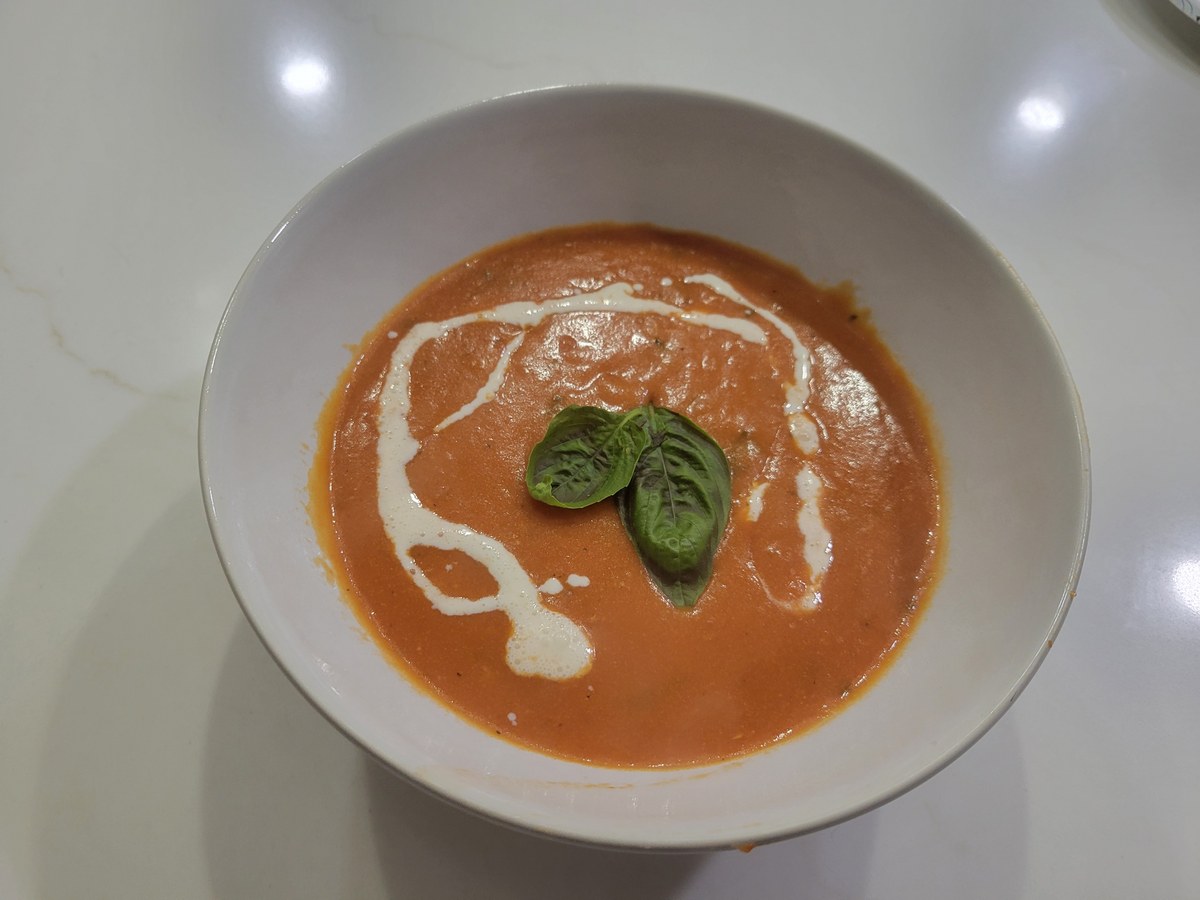
- Kill the heat. Stir in the cream. Off-heat. This matters. Cream dumped into boiling soup can split into curds and grease and then you are staring at a broken sauce with no easy fix. Kill the burner first, THEN stir in the cream slowly. The pot turns a warm orange-pink. Taste one last time and adjust seasoning.
- Ladle into bowls, top each with a fresh basil leaf (for good measure), and serve immediately with a grilled cheese. That's the pairing. That's the whole reason this dish exists. Don't be weird about it.
About the Word "Bisque" (We Need to Talk)
Technically, "bisque" is a French term for a smooth, cream-based shellfish soup. Lobster bisque. Crab bisque. Shrimp bisque. Traditionally, tomato soup is just called tomato soup. Somewhere along the way, "tomato bisque" became the accepted name for the creamy, roux-thickened, blended version of the dish, and now we're all using it, and we're not going back. Fine. But if you're the one at the table who wants to explain that "actually, bisque means shellfish" — yes. We know. Everybody knows. Sit down and eat your soup.
And yes, a proper lobster bisque is coming to this site. Eventually. It's roughly an eight-hour production spread across two days — shells roasted, stock built, strained, reduced, the whole ordeal — so I haven't made it in a while, and today is Friday, and I am not doing that today. When it lands you can throw this recipe in our face and be correct. Until then we are all pretending "tomato bisque" is a legitimate phrase, because the alternative — "creamy blended tomato soup with a roux" — is what a menu at a hospital cafeteria says. Bisque it is.
San Marzanos, Because We're Not Playing
For a soup that is almost entirely tomatoes, the tomatoes matter more than in almost any other dish. San Marzano tomatoes — Cento, La Valle, or another certified DOP brand — are meatier, sweeter, and less acidic than standard canned tomatoes. Two 28-oz cans of whole peeled is what this recipe is calibrated for. The bag of pre-crushed generic-brand cans will make a soup you'll describe as "fine." The San Marzanos will make a soup people ask for the recipe for. This is the one place in the pantry where spending an extra two dollars pays back immediately, and if you're going to use bad tomatoes for a soup that is 90% tomato, why are you here.
Whole peeled vs. pre-crushed: whole peeled is meatier, less watery, and less processed-tasting. Crushing them yourself takes ten seconds and is genuinely fun. The immersion blender will finish the job anyway. Buy whole peeled.
The Roux Is Not Scary
Flour cooked in fat for two minutes until it smells nutty. That is the entire technique. That is roux. It sounds French, which is why home cooks are terrified of it and skip it, which is why their tomato soup ends up thin and watery instead of velvety and coating. Two minutes. Don't burn it. That is the whole cliff. If you have ever made gravy from a can of pan drippings you have already made roux and you didn't even know it. Stop being scared of a two-syllable French word for "flour in butter."
The Sugar Is Not a Dessert Move
One tablespoon of sugar. Not to make the soup sweet. To cut the acid of the tomatoes. Canned tomatoes — even the good ones — are sharp, and a small amount of sugar rounds them out without making the soup taste sugary. The "no sugar in savory food, ever" nutrition-brain crowd will leave this out, eat sour soup, and blame the recipe. The recipe is fine. Put the sugar in.
Cream Goes In OFF the Heat
Once the soup is done simmering, kill the burner before you add the cream. Cream dumped into a boiling pot can split into curds and grease, and now you have a broken sauce and no easy fix and a bowl of unpleasant surprises. Off-heat, stir it in slow, whisk if needed. The soup stays smooth and glossy. This ten-second delay is the entire difference between a home tomato soup and a restaurant one. Restrain yourself for ten seconds. You can do it.
Buy an Immersion Blender
Thirty dollars. Does everything. Blends soup right in the pot, purées baby food, whips cream, emulsifies vinaigrettes, takes up less drawer space than a rolling pin. Anyone who ladles a boiling pot of tomato soup into a countertop blender is either a masochist or has never learned that hot liquid plus a sealed lid equals pressure and pressure equals your ceiling being red now. If you own exactly one kitchen appliance, own this one before you own a stand mixer. The Great Kitchen Ceiling Tomato Incident of 2003 was preventable. Yours can be too.
Serve With Grilled Cheese
This soup exists to be paired with a grilled cheese. That was the original comfort-food combo — the Campbell's condensed can and the Kraft-single grilled cheese on white bread, at somebody's grandma's house, in the '80s. This recipe is the adult version of both. Same nostalgia, better ingredients, actual technique. If you make the soup and skip the grilled cheese, you have missed the entire point of the exercise. It's called a "moment" for a reason. Do the pairing.