Ingredients
Small Batch (About 1 to 1.5 Cups Finished)
Canning Batch (About 6-7 Pints, Shelf-Stable)
Instructions — Small Batch
- Combine everything in a small saucepan. 2 cups frozen berries, 1 Tbsp sugar, 1 Tbsp lemon juice. Directly from the freezer into the pot — there is no thawing step. Thawing berries on the counter is just cooking them slower and grosser.
- Cook over medium heat. Not high. Medium. As the berries thaw they will release a startling amount of juice, and that juice is doing all of the work. Once you have a puddle at the bottom of the pot, take a fork or a potato masher and press the berries down until they are mostly broken up but still have some texture. You want a jammy consistency with visible chunks, not a smoothie.
- Simmer 10-15 minutes total, stirring occasionally, until the compote thickens slightly and coats the back of a spoon. It will thicken further as it cools, so pull it a hair earlier than you think you should — overreduced compote is a sticky purple gum, and nobody wants sticky purple gum on their yogurt.
- Off the heat. Let it cool. Twenty minutes on the counter, then into a jar, then into the fridge.
- Use within 1-2 weeks. Do NOT try to keep this at room temperature. The sugar and acid ratios in the small batch are not safe for shelf storage — a low-sugar preserve without processing is a bacteria hotel. If you want shelf-stable, you make the canning batch. Those are the choices.
Instructions — Canning Batch (Water-Bath, Shelf-Stable)
- Set up the canning gear first. Wash pint jars, lids, and rings in hot soapy water. Keep the empty jars hot — either in a 200°F oven or holding in the water-bath canner as the water comes up. Use fresh lids; reused lids are how seals fail, and a jar that doesn't seal is a jar that's about to become a science experiment. This is the boring part. Do it before you turn on the pot.
- Combine and cook. 8 cups frozen berries, 1.5 cups sugar, 4 Tbsp lemon juice into a large heavy-bottomed pot. Cook over medium heat, mashing with a potato masher as the berries thaw. Bring it to a rolling boil, then stir frequently to prevent scorching — sugar plus fruit plus a hot pot is exactly how you burn a batch, and you don't want to smell burnt raspberry for the next six hours. Cook 20-30 minutes until it's noticeably thickened; a spoonful drizzled onto a cold plate should hold its shape rather than run to the edge.
- Add 1 Tbsp bottled lemon juice to each hot pint jar. Directly into the empty, still-hot jar. This is the acidity insurance. Do this BEFORE you ladle the compote in. Skipping this because "there's already lemon juice in the pot" is exactly how home-canned food goes wrong — see the water-bath callout.
- Fill the jars. Ladle the hot compote into the hot jars, leaving 1/4 inch of headspace at the top. Not a full inch. Not to the brim. A quarter inch. Wipe the rims with a clean damp cloth — anything on the rim, even a smear of berry, can wreck the seal. Place a fresh lid on each and screw the ring on to fingertip-tight: snug, not cranked. The lid needs to be able to vent air during processing.
- Water-bath process. Lower the jars into the boiling water-bath canner using a jar lifter. The water must cover the tops of the jars by at least 1 inch. Once the water returns to a rolling boil, start the timer: 15 minutes for pints at sea level. Add time for altitude: 5 minutes for 1,000-3,000 ft, 10 for 3,000-6,000 ft, 15 for 6,000-8,000 ft. These are not suggestions. The USDA did the math.
- Cool undisturbed. Lift the jars out with the jar lifter and set them on a towel with an inch of space between each. Leave them alone for 12-24 hours. Do not poke them. Do not press the lids. Do not move them around to hear the "ping." They will ping when they ping. If you press a warm lid you can break the seal you just made, and then you did all this for nothing.
- Check the seals. After 12-24 hours the lid should be visibly concave (dipped in the middle) and should not flex when you press it. Any jar that didn't seal — the lid pops back at you — goes straight into the fridge and gets used within 2 weeks. It is not ruined. It is just fridge compote now. Sealed jars go into a cool, dark pantry and keep 12 months. Once you open a sealed jar, it lives in the fridge like anything else.
Small Batch vs. Canning Batch — Pick a Lane
Two versions, two sugar ratios, two purposes. The small batch is 1 Tbsp sugar per 2 cups of berries — light, fruit-forward, meant to sit in a jar in the fridge and get spooned onto things for a week or two. The canning batch is 1.5 cups sugar for 8 cups berries — jammier, sweeter, bigger yield, and the entire point is that you end up with six pints of shelf-stable stuff to give away or ration through the year. Do NOT try to can the small-batch recipe. The sugar and acid levels are not there for safe long-term preservation, and low-acid low-sugar preserves at room temp are how botulism happens. And do NOT make the canning batch just to eat within a week; you'll have used four times the sugar for no reason, and made twice as much dirty dishwater. If you want a week of yogurt-topper: small batch. If you want a pantry shelf: canning batch. There is no in-between.
The Compote Is a Multiplier
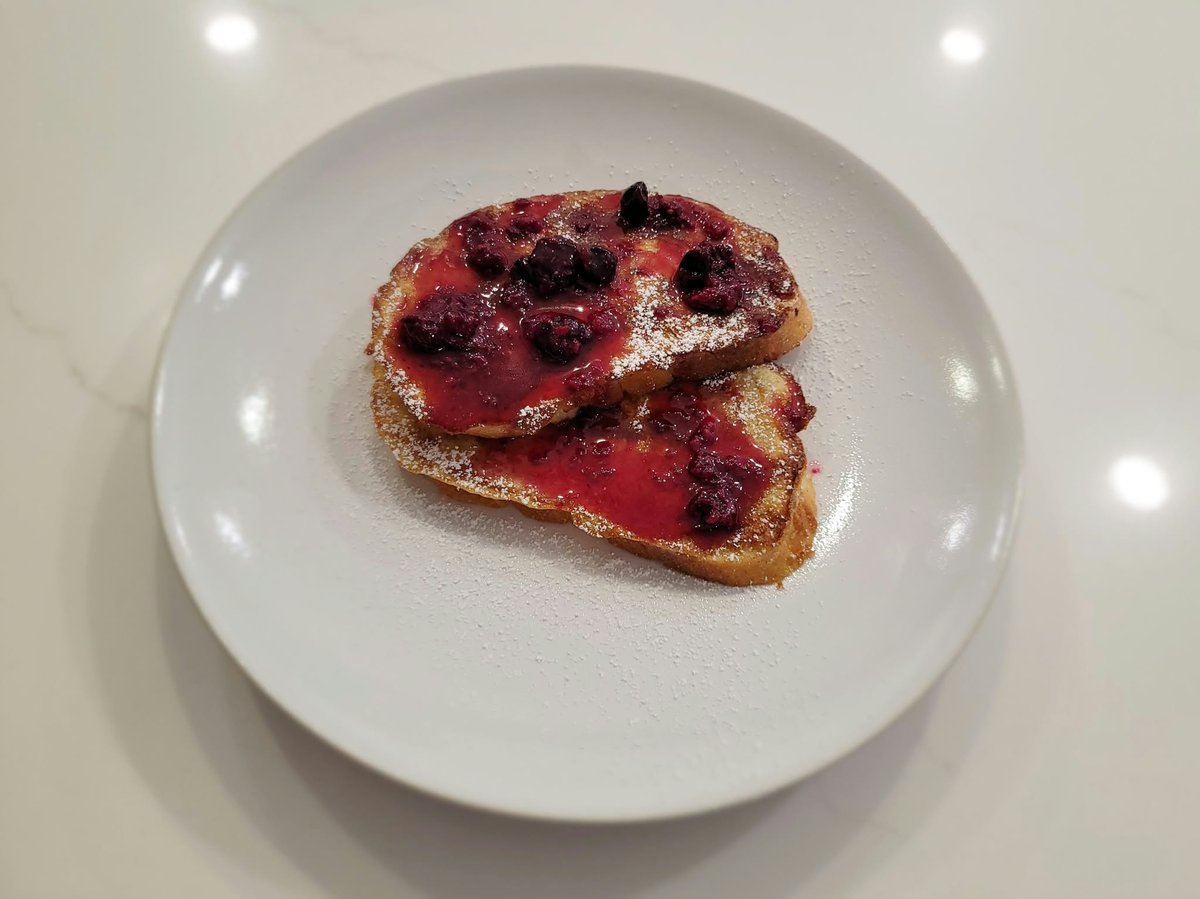
The whole pitch for this recipe is this: it takes your basic breakfast or dessert and makes it fancy. That is not a food-blog line, that is a fact. A jar of this in the fridge will improve everything you eat for the next week for zero additional effort. The list is long: on French toast, on French toast crostini, on Greek yogurt for breakfast, on vanilla ice cream for dessert, on cheesecake, on toasted English muffins with butter, on plain oatmeal, on waffles, on crepes, swirled into pancake batter, spooned over panna cotta, over pound cake. Also — a spoonful in a glass of sparkling water is a very good drink and nobody talks about it. The move is: keep a jar in the fridge and everything you eat for the next week is 40% fancier for zero effort. This is the highest-leverage thing you can do in a kitchen for the money, and it's made of frozen fruit.
Frozen Berries, Not Fresh
Use frozen. Not because "it works in a pinch," because it's better for this. Frozen berries are cheaper, already washed, and their cell walls are already ruptured from freezing — which is why they release juice the second they hit heat. Fresh berries at $6 a pint bleed less, need longer cooking to break down, and cost triple. If you are standing in a farmer's market in July with amazing fresh raspberries, sure, use those — you have earned it. Otherwise, the frozen aisle. It is cheaper AND objectively better for this specific job. Both. At the same time. You do not have to feel bad about the frozen bag.
Water-Bath Canning: The Rules Are Not Suggestions
If you're doing the canning batch to make shelf-stable jars, the rules that keep it food-safe are not optional and not up for a "my way" interpretation. Bottled lemon juice — not fresh — for the in-jar tablespoon; fresh lemon juice has variable acidity, and shelf-stable preserves need consistent pH. 15 minutes in boiling water at sea level is the minimum, and altitude adds time. Skipping the in-jar acid, shortening the processing time, or "eyeballing" the headspace is how home-canned food botulism happens. Botulism is a real thing. It is not a joke. It does not care that Grandma did it a different way for fifty years and nobody died. If any of this makes you nervous, skip it and make the small batch. Fridge-only compote is delicious, requires zero canning equipment, and has never killed anyone.
Berry Ratio: Equal Parts, Roughly
Equal parts strawberries, blueberries, and raspberries by volume. Roughly. If one of them is a little over or a little under, the compote does not care. If you only have two of the three, that is fine — a two-berry compote is a real thing. Blackberries make a perfectly good fourth berry if you like them. Pitted sweet cherries can swap in for one of the three. What matters is a mix, because a single-berry compote is a different (also fine) recipe. The three berries do different jobs: strawberries break down and give body, blueberries hold their shape and give bite, raspberries color the whole thing that deep jewel red. Skip any one and it's a different picture. But close enough is close enough.